Did you know that a free ticket is called an "Annie Oakley"? (I didn't either, and maybe, since ticket takers no longer punch holes in tickets, this usage is becoming outdated.)
When you get an admission ticket for free ahead of time, it is hole-punched just like it would have been had you used it to gain entry. And then it looks just like Annie's Ace of Hearts: one of her most famous sharpshooting tricks was a bullet through the center of a playing card, the Ace of Hearts, at 90 feet with a .22 caliber rifle. (She could also split the card edge-on.)
Annie was born to a poor Quaker family in Ohio in 1860. She taught herself to shoot when she was 8 years old and supported her family by selling the game she bagged to families, restaurants, and hotels in Southern Ohio. By the time she was 15, she had paid off the mortgage on her mother's farm.
For two of those years, 1870 to 1872, her mother could not take care of her and her sister and sent them to Darke County Infirmary, where she learned to sew and embroider. (Later, as a performer, she made her own costume, according to her idea of modesty: long-sleeved blouse, below-the-knee skirt, and leggings.) She was put out as an indentured servant to a couple she later called "the wolves"; they abused her physically and mentally and treated her like a slave.
When she was 15, she won a shooting contest with a traveling Irish marksman, Frank Butler, who had bet a hundred dollars that he could beat any local fancy shooter. They were married soon after, in 1876. In 1885, they joined Buffalo Bill's Wild West Show, left the wild west show and toured Europe, and returned to the show. Her fellow performer Chief Sitting Bull named her Watanya Cicilla, or Little Sharpshooter.
In later years, Annie was injured in a train collision and a car accident and turned to acting. But she continued to set sharpshooting records. Although she did not think women should have the vote, she taught many women to shoot and occasionally supported young women who needed financial help. When she died, at age 66, her husband quit eating and died 18 days later: a real-life love story.
With much indebtedness to the Wikipedia article on Annie Oakley.
Tuesday, May 7, 2013

Sunday, May 5, 2013
Spine Poetry
Think "spine poetry." Now close your eyes. What comes to mind? Turns out you're supposed to take book titles as printed on book spines and arrange them in a stack so that they can be read as poems.
Spine poetry is the creation of artist Nina Katchadourian, who began her "Sorted Books" project in 1993 and just published, with Brian Dillon, twenty years of her own images in Sorted Books (San Francisco: Chronicle Books, 2013).
I first heard about spine poetry during National Poetry Month, April, when the local city library I volunteer at had a brief presentation introducing the "Spine Art" installation at the Library of Congress. (Although I would like very much to create timely posts, for example, a just-pre-April post to coincide with National Poetry Month or the "Spine Art" installation, I'm not sure I can commit to that. And then, where does it end? Do I write a themed post for every calendar event in the fields of Literature and Language? You see the dilemma.)
My musings on spine poetry: First note that a picture person, not a word person, came up with it. A lovely idea, very fun, according to which books become objects, just like they do when interior decorators arrange books on the coffee table by cover photo or on the bookshelf by color or size.
Objects as opposed to what? Of course books are objects. But they are, and especially were, also the keepers and purveyors of civilization. And the more we are aware of that, as we are during a time of extreme change, the more books also become objects, whether to be collected, published in attractive series (like Penguin's modestly priced "Hardcover Classics'), cannibalized (as by publishers who depart from the 500-year-old principles of book design by placing an index, for example, with the front matter), or used as building blocks for structures or works of art.
We (civilization, such as it is at this point) are in the midst of a change of untold proportions in moving our print archives to the Internet. Assuming, that is, that we can keep track of the technology, a nagging problem for those of us who have lived through the transition from slides to celluloid film to digital "film" or records to tapes to dvds.
Spine poetry is the creation of artist Nina Katchadourian, who began her "Sorted Books" project in 1993 and just published, with Brian Dillon, twenty years of her own images in Sorted Books (San Francisco: Chronicle Books, 2013).
I first heard about spine poetry during National Poetry Month, April, when the local city library I volunteer at had a brief presentation introducing the "Spine Art" installation at the Library of Congress. (Although I would like very much to create timely posts, for example, a just-pre-April post to coincide with National Poetry Month or the "Spine Art" installation, I'm not sure I can commit to that. And then, where does it end? Do I write a themed post for every calendar event in the fields of Literature and Language? You see the dilemma.)
My musings on spine poetry: First note that a picture person, not a word person, came up with it. A lovely idea, very fun, according to which books become objects, just like they do when interior decorators arrange books on the coffee table by cover photo or on the bookshelf by color or size.
Objects as opposed to what? Of course books are objects. But they are, and especially were, also the keepers and purveyors of civilization. And the more we are aware of that, as we are during a time of extreme change, the more books also become objects, whether to be collected, published in attractive series (like Penguin's modestly priced "Hardcover Classics'), cannibalized (as by publishers who depart from the 500-year-old principles of book design by placing an index, for example, with the front matter), or used as building blocks for structures or works of art.
We (civilization, such as it is at this point) are in the midst of a change of untold proportions in moving our print archives to the Internet. Assuming, that is, that we can keep track of the technology, a nagging problem for those of us who have lived through the transition from slides to celluloid film to digital "film" or records to tapes to dvds.
Thursday, March 28, 2013
Sweet Tooth
Long ago, from an etymological resource I can no longer find, I learned that people who enjoyed sweets were thought to have an extra tooth, the sweet tooth. People with a sweet tooth love--or even crave--sugar, candy, cookies, pastries, desserts, ice cream.
Test: do you find yourself standing at the kitchen cupboard, spoon in hand, eating the lumps that have formed in the brown-sugar bag? Do you know that you can actually create these lumps by adding a few drops of water to the bag ahead of time? No? Ahem. (Reclaiming dignity.)
Anyway, I inherited this sweet tooth from my Danish grandfather, all five feet four inches of him. (As the elder daughter of an only child, I also inherited boxes-ful of family information, including his naval record, which gives his barely regulation height.)
Somewhere in there is a letter he wrote home during the Great War. He enlisted right after America joined the war, April 1917, and set sail for France as the bursar of a naval troop-transport ship. He writes that his favorite thing to do is go up on deck with a box of chocolates and eat them all up.
Meanwhile, as for the things that keep a word nerd up at night:
Elder because in comparisons of two, your only choices are younger or older, the comparative form; in comparisons of three or more, you have old, older, and oldest, the superlative form. So if I had two sisters instead of one, I would be the oldest. And, as my sister reminds me, I will always be older.
As for giving my grandfather's height, I had several choices:
five feet four inches
5ft 4in
5' 4"
I chose the version I did because it fit with the easy-to-read vibe of an informal essay.
Test: do you find yourself standing at the kitchen cupboard, spoon in hand, eating the lumps that have formed in the brown-sugar bag? Do you know that you can actually create these lumps by adding a few drops of water to the bag ahead of time? No? Ahem. (Reclaiming dignity.)
Anyway, I inherited this sweet tooth from my Danish grandfather, all five feet four inches of him. (As the elder daughter of an only child, I also inherited boxes-ful of family information, including his naval record, which gives his barely regulation height.)
Somewhere in there is a letter he wrote home during the Great War. He enlisted right after America joined the war, April 1917, and set sail for France as the bursar of a naval troop-transport ship. He writes that his favorite thing to do is go up on deck with a box of chocolates and eat them all up.
Meanwhile, as for the things that keep a word nerd up at night:
Elder because in comparisons of two, your only choices are younger or older, the comparative form; in comparisons of three or more, you have old, older, and oldest, the superlative form. So if I had two sisters instead of one, I would be the oldest. And, as my sister reminds me, I will always be older.
As for giving my grandfather's height, I had several choices:
five feet four inches
5ft 4in
5' 4"
I chose the version I did because it fit with the easy-to-read vibe of an informal essay.
Saturday, December 8, 2012
The Castle Ad
Progressive is running an ad on TV, the "Castle Ad." In the course of the dialogue, Marge remarks, "We have broughteth a bounty of discounts to our customers."
What she should have said, of course, is "We have brought a bounty of discounts to our customers," because the verb bring has never taken the form, "broughteth," whether during the period castles were built or now. But that doesn't sound archaic enough.
Now, I say to my little-old-lady teacher within, why should we care? People will think we are carping needlessly about something that is meant to be silly. Can't we just go along with the joke?
Well, of course. And if you think so too, then my blog is not for you. Just say, get a life and be done with it.
But if you are like me, this is your life and you cannot be done with it. You start thinking things like, what if readers come to Chaucer and Shakespeare and expect language to be a free-for-all, instead of the foundation of the grammar, rhetoric, and usage we still use today?
What if somebody thinks bring has a very fluid form, instead of a real conjugation?
And other questions of equal gravity.
Saturday, December 1, 2012
The Scarlet Pimpernel
I am rereading the Scarlet Pimpernel (London: Hutchison), a wonderful romantic, swashbuckling, 1905 adventure novel by Baroness Emmuska Orczy, set during the early French Revolution. Our hero, Sir Percy, passes for a foppish baronet. His alter ego, the Scarlet Pimpernel, along with nineteen friends, smuggles French aristocrats to England before they are guillotined by French revolutionaries in the Reign of Terror. After each successful venture, Sir Percy or one of his company leaves a scrap of paper with a drawing of the little red flower, the pimpernel.
Just as Dickens introduced the first detective in literary history, Inspector Bucket in Bleak House, so, according to the Wikipedia entry, at least, Orczy gives us the first hero with a secret identity, the ancestor of Batman, Spider-Man, and Superman.
I say rereading because I know I must have read it a hundred years ago. As a teenager, my dad read his way through the Santa Barbara Library, dictionaries and all. At some point in my young life, he mentioned this book, and so I read it.
But I did not follow my own rule: if you don't know a word, put down what you are reading and look it up. I know this because I just now came across the word defalcation, which, as it happens, means embezzlement, and did not know its meaning. Apparently, I just could not drag myself away from the story to look it up in a dry old dictionary.
To this day, I still love the hero who lives as Everyman but does great deeds in secret. And I try to follow my own rules.
Just as Dickens introduced the first detective in literary history, Inspector Bucket in Bleak House, so, according to the Wikipedia entry, at least, Orczy gives us the first hero with a secret identity, the ancestor of Batman, Spider-Man, and Superman.
I say rereading because I know I must have read it a hundred years ago. As a teenager, my dad read his way through the Santa Barbara Library, dictionaries and all. At some point in my young life, he mentioned this book, and so I read it.
But I did not follow my own rule: if you don't know a word, put down what you are reading and look it up. I know this because I just now came across the word defalcation, which, as it happens, means embezzlement, and did not know its meaning. Apparently, I just could not drag myself away from the story to look it up in a dry old dictionary.
To this day, I still love the hero who lives as Everyman but does great deeds in secret. And I try to follow my own rules.
 |
| Anagalis arvensis, the scarlet pimpernel, a low-growing plant in the primrose family native to Great Britain. CC by-SA 3.0. Created by Jean-Jacques Milan. |

Tall, Grande, Venti
My philosopher friend went into a Starbuck's and asked for a tall glass of water.
The barista said, "Do you want a tall, like a Starbuck's tall, or do you want a really tall glass of water?"
Now Starbuck's, as I and other word-nerd customers discovered early on, have introduced some understandable confusion. When you order at Starbuck's, you are supposed to use tall to mean a small 12-oz. drink, grande ("large" in Italian) to mean a medium 16-oz. drink, and venti ("twenty" in Italian) to mean a large 20-oz. drink.
So my friend thinks, "If Starbuck's doesn't know the real definition of tall, we're in big trouble!"
He was telling me this story and, as a word-nerd bonus, it came up that he had deduced that tall must be an Italian word like grande and venti.
A logical assumption, and my friend is logical. Unfortunately, not true. Tall is from Old English tæl, ġetæl.
All of which goes to show the mischief inherent in redefining good old English words and mistranslating good old Italian words.
The barista said, "Do you want a tall, like a Starbuck's tall, or do you want a really tall glass of water?"
Now Starbuck's, as I and other word-nerd customers discovered early on, have introduced some understandable confusion. When you order at Starbuck's, you are supposed to use tall to mean a small 12-oz. drink, grande ("large" in Italian) to mean a medium 16-oz. drink, and venti ("twenty" in Italian) to mean a large 20-oz. drink.
So my friend thinks, "If Starbuck's doesn't know the real definition of tall, we're in big trouble!"
He was telling me this story and, as a word-nerd bonus, it came up that he had deduced that tall must be an Italian word like grande and venti.
A logical assumption, and my friend is logical. Unfortunately, not true. Tall is from Old English tæl, ġetæl.
All of which goes to show the mischief inherent in redefining good old English words and mistranslating good old Italian words.
Thursday, November 1, 2012
Words Take Flite
Miss Flite is a secondary character in Dickens's great novel, Bleak House, first published in serial form between March 1852 and September 1853. Her first appearance is in Chapter 3, when, as Esther writes, "a curious little old woman in a squeezed bonnet, and carrying a reticule, came curtsying and smiling up to us, with an air of great ceremony." She wants to meet Ada and Richard, wards in the Chancery case Jarndyce and Jarndyce, as she once was, and their companion, Esther.
She has a bird-like quality about her, evident in her name, in her person (we get to see her in Phiz's wonderful etching), in the birds she keeps caged in her garret, and in her role as messenger of doom. Richard, despite the softening influence of Esther and Ada, becomes obsessed with the case and finally dies after it is settled--or rather just plain old terminated, because the entire estate has been "absorbed in costs."
Dickens never says, Miss Flite is like a bird (in which case, in every passage she appears in, she would provide an excellent example of a simile). This not dramatic enough for Dickens's purposes. Instead, she is a wonderful example of metaphor. Figuratively, she is a bird.
She has a bird-like quality about her, evident in her name, in her person (we get to see her in Phiz's wonderful etching), in the birds she keeps caged in her garret, and in her role as messenger of doom. Richard, despite the softening influence of Esther and Ada, becomes obsessed with the case and finally dies after it is settled--or rather just plain old terminated, because the entire estate has been "absorbed in costs."
Dickens never says, Miss Flite is like a bird (in which case, in every passage she appears in, she would provide an excellent example of a simile). This not dramatic enough for Dickens's purposes. Instead, she is a wonderful example of metaphor. Figuratively, she is a bird.
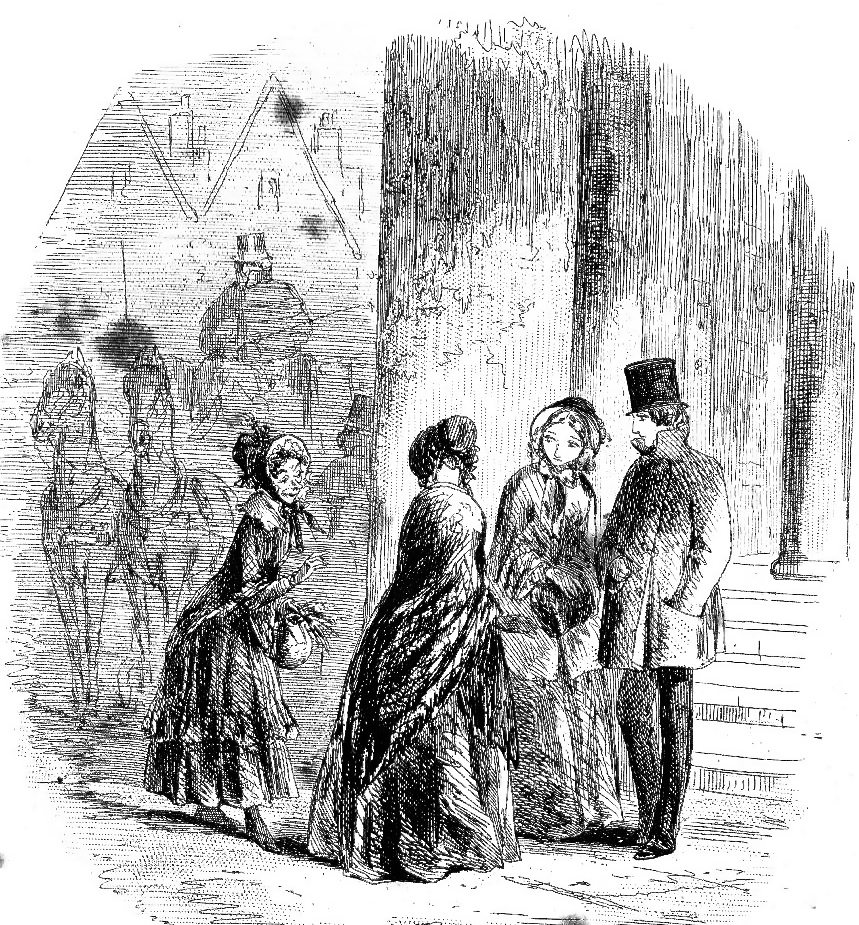
Miss Flite with the wards of Jarndyce & Jarndyce.
Subscribe to:
Posts (Atom)