Showing posts with label Elizabeth. Show all posts

Monday, November 23, 2015

Pride and Prejudice

So one of my favorite examples of ekphrasis is the shield-of-Achilles passage in the Iliad. By the way, I didn't tell you in the last post, but "ekphrasis," from the ancient Greek, means to call out or draw attention to.

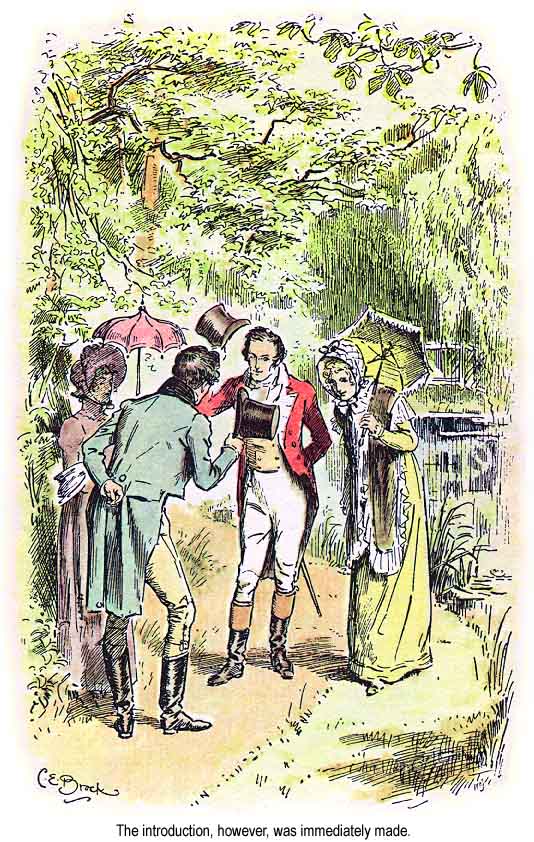
My other favorite example of ekphrasis is in Chapter 43 of Jane Austen's Pride and Prejudice. Darcy's miniature, his portrait, his gallery, his housekeeper and his sister, his home, his pond, his estate, indeed, the whole of Pemberley, show Darcy's excellent character. Entirely in his absence, his handsome, moderate, reasonable self is revealed. In the negative, as it were.

But then, in a moment of stunning drama, and to Elizabeth's great confusion, he appears unexpectedly from the outer edge of the estate. And he turns out to be as charming as his world, Pemberley, has suggested.

Elizabeth's visit to Pemberley is a turning point in the story. Elizabeth thinks with longing, in support of the satirical theme of the novel to marry well, "And of this place . . . I might have been mistress!" Elizabeth's visit is also in support of the deeper theme, of finding balance in marriage and in life, which in this case will consist in finding an excellent husband for the heroine, who by now has become our Elizabeth, and an excellent wife for Darcy.
Monday, July 1, 2013

Summer Reading

My dear food-writer and foodie friend has said several things to me that have changed my life. My favorite is, "Whenever I don't know what to read, I read Pride and Prejudice. That way, I'm never disappointed."

When my daughter had cancer and our family went through two years of hell trying to save her life (and succeeding), I read Jane Austen's Pride and Prejudice (London: T. Egerton, 1813). When my husband was ill with ALS (Amyotrophic Lateral Sclerosis--also known as Lou Gehrig's disease), I read Pride and Prejudice. I read it after I was widowed, and look forward to starting it again this hot summer evening.

I confess that, until lately, I have been thrown by Elizabeth's answer to her sister's question, "How long have you loved him?" It sounds so flip.

Elizabeth says, " . . . I hardly know when it began. But I believe I must date it from seeing his beautiful grounds at Pemberley." (Notice that in most of the recent mini-series and movie adaptations, script writers rarely change Austen's dialogue, because each bit of dialogue is so perfect for the person who says it. And this is so perfect for Elizabeth.)

She makes a sly allusion to the theme of the novel, "It is a truth universally acknowledged, that a single man in possession of a good fortune, must be in want of a wife." Our Elizabeth cannot resist a little humor, even though she takes the joke seriously. But, without pride or prejudice, and now having seen Darcy's estate, she knows what kind of man he truly is. The fields and forests and lakes are well-managed and productive, the people who serve him admire their master for his kindness and fairness, and the house itself, without being showy, shows off his handsome demeanor and his well-ordered and cultivated mind.

Elizabeth sees a union for herself not with a self-important nitwit like Mr. Collins, not with a thoughtless wastrel like Wickham, not with a man who long ago lost his common sense to beauty alone, like her father, but a marriage that truly contributes to the society in which it flourishes.