Okay, all right! (Yes, okay should be spelled out, not abbreviated o.k. and all right is two words.)
Once again, you know more about me than I wish you did. Although, along those lines, I have to say that the best writing is, at its heart, honest.
I cannot depend on myself to complete the tasks I've set for myself (to say nothing of the tasks other people might like to set for me). I wrote a post on Connelly's Parthenon Enigma and planned to write two more posts on current archaeology books, Brier's Secret of the Great Pyramid and Cline's 1177 B. C.: The Year Civilization Collapsed.
And, just so we're square, the thesis of Brier's book is a theory developed by French architect Jean-Pierre Houdin, in turn based on his father's insight (his father is also an architect) that the Great Pyramid at Giza was built by means first of an exterior ramp and then an interior ramp.
The thesis of Cline's book is that the migration or invasion of the Sea Peoples, so-called, who probably came from Western Europe, may have brought about the catastrophic collapse of the Late Bronze Age. I read carefully, but did not come away with more information than that.
Why is it, I often wonder, that I am not good at assigning myself posts. And the best, and most flattering, answer is that these posts "come" to me. I have an idea for a post and, at first, the idea is a gift. Then it becomes a possibility--"Oh," I think, "that might work"--and let my thoughts play with the idea. And finally it becomes a demand: "I'm not going to be able to put this idea to rest, or get any rest myself, for that matter, until I write the damn thing."
So now you know.
Showing posts with label Eric H. Cline. Show all posts
Showing posts with label Eric H. Cline. Show all posts
Saturday, September 27, 2014

Wednesday, August 27, 2014
Archaeology Best Sellers, In Three Parts. Part 1: Connolly
Every once in a while, I read a popularized archaeology book that catches my eye. Lately, for example, I've made my way through The Parthenon Enigma, by Joan Breton Connolly (New York: Knopf, 2014); The Secret of the Great Pyramid, by Bob Brier (New York: Harper Perennial, 2009); and 1177 B.C.: The Year Civilization Collapsed, by Eric H. Cline (Princeton: Princeton University Press, 2014).
And I mean "made my way." Except for the dramatic, thriller-style titles, these books, although well-reasoned, are not well-written. They are scholarly works, complete with heavy words and plodding arguments, dressed up as best sellers.
Maybe these works can get away with looking like--yes, even acting like--best sellers, because their main ideas are so great.
In the Parthenon Enigma, Connolly argues that the Parthenon frieze "tells" the founding myth of Athens, in which Athens's first king, Erechtheus, sacrifices his daughter to save the city. We had lost track, not of the myth itself but of its importance, until we recently recovered a play by Euripides that tells the tale.
Connolly debunks the idea that the frieze shows the procession of the Panathenaea, the great annual festival of the city, which is how we had been used to interpret the frieze.
Connolly debunks the idea that the frieze shows the procession of the Panathenaea, the great annual festival of the city, which is how we had been used to interpret the frieze.
As part of her argument, Connolly depicts all ninety-two marble metopes, or panels carved in bas-relief, from the Parthenon frieze. (In a typical Doric frieze such as this, metopes alternate with triglyphs, carved marble panels with three vertical lines, perhaps memorializing the beam ends of ancient wooden structures.)
The British Museum holds most of the metopes as part of the Elgin Marbles. The new Parthenon Gallery of the Acropolis Museum and six other institutions hold the rest.
Connolly remarks that part of the problem in the misinterpretation of the frieze lies with the loss of Euripides's tragedy and part with the diaspora of the marbles themselves. Scholars could have looked at them as a single narrative, but, having to work with the same limitations as the rest of us human beings, they did not.

The British Museum holds most of the metopes as part of the Elgin Marbles. The new Parthenon Gallery of the Acropolis Museum and six other institutions hold the rest.
Connolly remarks that part of the problem in the misinterpretation of the frieze lies with the loss of Euripides's tragedy and part with the diaspora of the marbles themselves. Scholars could have looked at them as a single narrative, but, having to work with the same limitations as the rest of us human beings, they did not.
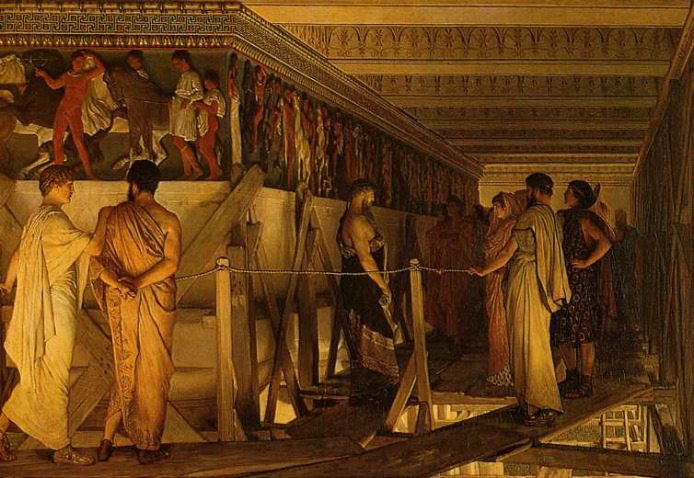
Phidias Showing the Frieze of the Parthenon to his Friends, by Sir Lawrence Alma-Tadema, 1868, held by Birmingham Museums And Art Gallery.
Part 2: Brier.
Part 3: Cline.
Part 2: Brier.
Part 3: Cline.
Subscribe to:
Posts (Atom)