In On Her Majesty's Secret Service, James Bond returns to Royale-les-Eaux to visit the grave of Vesper Lynd, a yearly pilgrimage of his. On the road, he and the mysterious, and reckless, Contessa Teresa "Tracy" di Vicenzo race each other in their cars. Later they meet face to face in the casino, where Bond, even though he barely knows her, covers her gambling debt to save her from a dishonorable loss, un coup de deshonneur.
But Tracy is worse than reckless; she is suicidal. The next day, Bond interrupts her while she is trying to kill herself.
Bond finds himself talking alone to Tracy's father, Marc-Ange Draco, head of the Corsican Mafia and holder of the King's Medal for Resistance Fighters (so, even though a criminal, a good guy). Draco convinces Bond to make love to his daughter, to give her hope enough to stay alive, and admonishes him to keep their conversation herkos odonton, which, he says, is Greek for top secret.
Now according to Hank Prunckun, in Counterintelligence Theory and Practice, this Greek saying probably comes from a passage in the Odyssey in which Zeus asks Athena to be careful about letting information slip so easily through the barrier (herkos) of her teeth (odonton).
I am easily amused, and I have been having fun imagining the school boy, Ian Fleming, coming across this phrase and tucking it away in his mind. "Someday," he thinks, "I'll find a use for this wonderful phrase, herkos odonton; I just know I will."
Showing posts with label James Bond. Show all posts
Showing posts with label James Bond. Show all posts
Tuesday, August 19, 2014

Tuesday, August 12, 2014
Casino Royale
The time has come, I'll wager, for an annotated edition of Casino Royale (first published in London by Jonathan Cape Ltd in 1953).
Case in point:
Bond is at the roulette table. He has lost the money his government bankrolled him so that he could clean out the villain, Le Chiffre. He is despondent, with nowhere to turn. What can he do now?
His American spy friend, Felix Leiter, slips him a new stake, an envelope full of cash, and says, "Marshall Aid. Thirty-two million francs. With the compliments of the USA."
Note:
After the devastation of World War II, Europe struggled to rebuild. The Marshall Plan, named for Secretary of State George Marshall, provided $13 billion in economic grants and loans to the United Kingdom, France, and other European nations, including enemy combatants, Austria, Italy, and West Germany, over a four-year period from 1948 to 1951. The idea was that the slow start of economic regrowth in postwar Europe could make countries vulnerable to Soviet Communism and a little stimulus could help prevent this.
So Felix is joking with Bond. Just as the United States provided economic stimulus to Europe, so Felix helps Bond with the money he needs to beat Le Chiffre.
Case in point:
Bond is at the roulette table. He has lost the money his government bankrolled him so that he could clean out the villain, Le Chiffre. He is despondent, with nowhere to turn. What can he do now?
His American spy friend, Felix Leiter, slips him a new stake, an envelope full of cash, and says, "Marshall Aid. Thirty-two million francs. With the compliments of the USA."
Note:
After the devastation of World War II, Europe struggled to rebuild. The Marshall Plan, named for Secretary of State George Marshall, provided $13 billion in economic grants and loans to the United Kingdom, France, and other European nations, including enemy combatants, Austria, Italy, and West Germany, over a four-year period from 1948 to 1951. The idea was that the slow start of economic regrowth in postwar Europe could make countries vulnerable to Soviet Communism and a little stimulus could help prevent this.
So Felix is joking with Bond. Just as the United States provided economic stimulus to Europe, so Felix helps Bond with the money he needs to beat Le Chiffre.
Monday, July 28, 2014
What Is a Sabretache?
James Bond is in Royale-les-Eaux, a fictional fishing village on the coast of Britanny. Royale-les-Eaux was twice a fashionable health spa, once during the Second Empire and again at the turn of the nineteenth century. Now, in the early 1950s, it is a gambler's paradise, where the worldly can play baccarat and other games of chance at the Casino Royale.
Bond is meeting Mathis, his MI6 contact, over lunch at the Hermitage. Mathis will introduce him to Mlle. Vesper Lynd, the woman who will help him in the operation to bankrupt Le Chiffre.
At this first meeting, the beautiful Lynd wears a grey silk dress with a square neck, tight bodice, and slightly full skirt; her waist is encircled by a black, 3-inch-wide, hand-stitched belt. (The dress is by Dior, as it turns out.) Her shoes are a matching black and her hat, a large "cart-wheel" of gold straw, has a black ribbon. Around her neck, a gold flat-link chain lights up her sun-tanned skin; on her finger, a "broad" topaz ring picks up the gold of the necklace and the straw hat.
Her purse is a black, hand-stitched sabretache, a military pouch once carried by Magyar horsemen of the tenth century; we have examples of these pouches as grave goods. Then called a tarsoly, the pouch was suspended from the belt with the saber and so hung under the saber and to the rider's left side. It was often embellished with a coat of arms or monogram on the front flap.
Hussar cavalry soldiers adopted the tarsoly, in part because their uniforms were so tight that there was no room for pockets, but changed the name: German sabel for saber plus tasche for pocket became sabretache.
British cavalry in the Crimean War (1853-1856) still carried sabretaches. According to the Wikipedia entry, "'undress' versions in plain black patent leather were used on active duty."
So to complete the picture of Miss Lynd, this is how I see her sabretache: it is plain, but shiny, black patent leather like those British cavalrymen used in the Crimea.
Hussar cavalry soldiers adopted the tarsoly, in part because their uniforms were so tight that there was no room for pockets, but changed the name: German sabel for saber plus tasche for pocket became sabretache.
British cavalry in the Crimean War (1853-1856) still carried sabretaches. According to the Wikipedia entry, "'undress' versions in plain black patent leather were used on active duty."
So to complete the picture of Miss Lynd, this is how I see her sabretache: it is plain, but shiny, black patent leather like those British cavalrymen used in the Crimea.
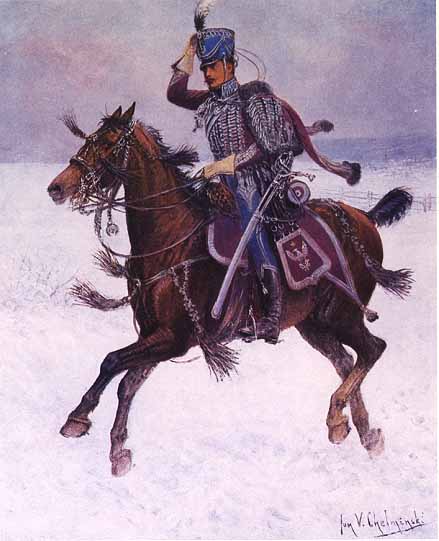 |
| A Hussar officer in full dress, army of the Duchy of Warsaw in 1807. His sabretache is emblazoned with the White Eagle of Poland. Painting by Jan Chełmiński, 1913. |
Subscribe to:
Posts (Atom)