Showing posts with label decorative arts. Show all posts

Monday, July 1, 2013

Singerie

Singerie, French for "monkeyshines" and a kind of chinoiserieis a design motif in which monkeys join a fun-loving crowd of partiers. Like chinoiserie, it is supposed to provide a gently mocking view of the human condition.

Singerie became fashionable in late 17th-century and 18th-century France and is typically associated with Rococo decorative painting. A primary example of which is the breathtaking Grande Singerie, a recently restored boudoir in the Chateau de Chantilly.

What a great word, singerie! and a loan word at that. And one that is unfamiliar enough that I will continue to italicize it, even though I would not italicize more well-known loan words, like subpoena or faux pas.

To this day, we have sophisticated examples of singerie, in textiles, for example. Just take a look at ScalamandrĂ©'s wonderful Chinoise Exotique.

But my earliest exposure was to popular singerie. I don't know how many yellow kitchens I went into as a child, on whose walls were a "praying hands" plaque or a Pennsylvania Dutch saying, "Too soon old, too late schmart." Similarly, there could be a monkey see, monkey do relief or a see no evil, hear no evil, speak no evil statuette.

Well, enough monkeyshines and on to more serious matters.
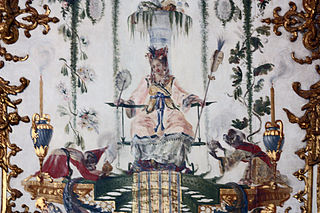

Detail of the allegory of the theater.

This file is licensed under the Creative Commons Attribution-Share Alike 3.0 Unported, 2.5 Generic, 2.0 Generic and 1.0 Generic license.

Monday, June 10, 2013

Chinoiserie

My dear soul-mate friend gave me my own little piece of chinoiserie, the rice bowl her great-aunt carried with her on missions to 1890s China. Miss Nellie (her name, as far as I can recollect) hoped to convert to Christianity those whom she thought of as heathen. What courage! what faith! what a sense of righteousness! to head off to an unknown land hoping that foreigners will fill up your rice bowl.

Chinoiserie, French for "Chinese in design or evocative of Chinese design," became fashionable in seventeenth-century Europe and has been in vogue ever since. Although there are similar allusions to other exotic cultures in the decorative arts, Moroccan, for instance, or Persian, there is no all-encompassing word that I know of for these other influences.

Like the travelogue in literature, chinoiserie (and other decorative allusions) give Westerners a peek into another culture, so that, by momentarily becoming outsiders, we gain insight into our own foibles and proclivities and see the other as ourselves.

Amazingly, when Miss Nellie is carrying her rice bowl among the unsaved, it is not chinoiserie. It becomes chinoiserie when it takes up residence in a Western home like mine.