Showing posts with label plantation. Show all posts

Friday, August 16, 2013

Tea-Garden Time

Lately, between dinnertime and bedtime, I have been feeling as tired as the wrung-out dish rag in the kitchen sink. One evening, I made myself a cup of Assam tea, which, the tea container assured me, was very good with milk. ("And sugar!" I said to myself.) It gave me a little pick-me-up, did not irritate my stomach like Chinese tea does, and did not keep me up all night like coffee would have.

Assam tea is brewed from the leaves of Camellia sinensis var. assamica, the tea bush native to the river-valley lowlands of the small state of Assam in northeastern India. This tea bush is different from its cousin Camellia sinensis var. sinensis, the Chinese tea bush native to the southern highlands of China. And, by the way, these are the only two places in the world where tea bushes grow naturally.

The Chinese discovered tea five thousand years ago. According to the charming legend, emperor and herbalist Shennong had his attendants boil all his water for purity. One day they presented him with a cup of boiled water into which a leaf from the Chinese tea bush had inadvertently fallen. He noticed the restorative property of the drink and . . . end of story! Soon tea became popular throughout China. Chinese tea was introduced to the west by Portuguese priests and merchants in the sixteenth century and was all the rage in Europe by the seventeenth-century.

I am pretty sure that Assam tea was discovered at about the same time as Chinese tea, but it was not introduced to the west until the early 1800s. A Scottish adventurer, Robert Bruce, discovered Camellia sinensis var. assamica in 1823. After his death, about 1830, his brother had the bush verified in Calcutta as being similar to, but a distinct variety of, the Chinese tea bush. By the late 1830s, the East India Company test-marketed Assam tea in London and soon instituted policies encouraging British subjects to lay claim to land in Assam and plant tea-garden estates.

Note the rather deceptive use of the term "tea garden" (to say nothing of "lay claim to land"). We are talking about plantations, which, in order to prosper, depend on an owner-slave or at least a master-serf relationship to keep the cost of production down, no matter whether tea, coffee, sugar, rice, or tobacco is being grown.

Based on plantation custom, the Assam tea gardens are on Tea Garden Time, one hour ahead of the Indian Standard Time (IST) observed throughout the rest of India and Sri Lanka. It is sort of a daylight savings time, so that the workers get as much time in the fields as possible in the sunlight between 9:00 am (IST 8:00 am) and 5:00 pm (IST 4:00 pm).

So while I am sipping my restorative cup, around 8:00 at night "tea-garden time," and resting from my labors--or maybe even inspired to take them up again for pleasure--the plantation workers in Assam are just beginning their field work for the day.
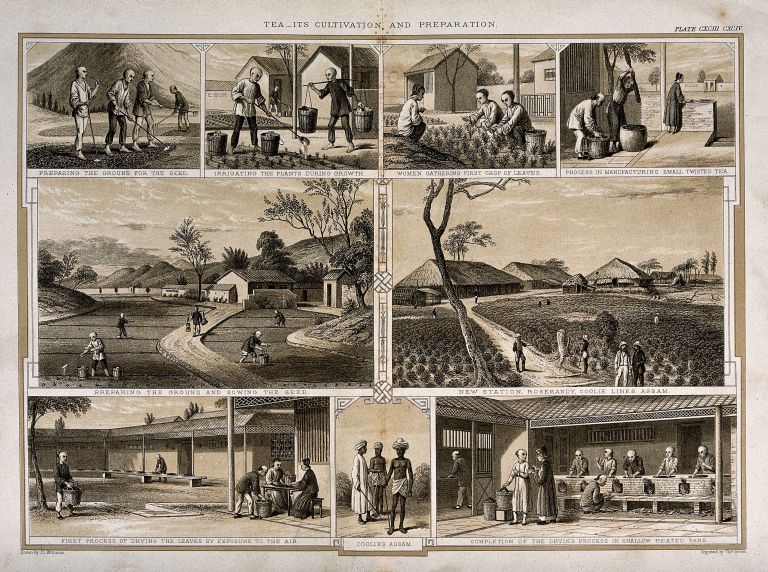

1850 engraving of Assam tea production.


Saturday, August 3, 2013

Monticello Soup

Once I finished writing the Monticello post, I had some "leftovers." So, Monticello soup.

Not only did Thomas Jefferson design (and, after seeing European and classical architecture,) redesign Monticello himself, he built in a few ingenious things to make life easier. A hideaway bed. A revolving clothes horse with 48 arms, sort of like a spiral dry cleaner's rack hung vertically. A revolving book stand for five open books at a time, which folds up into a cube for storage.

And the first dome in America. Although beautiful and stately, the room under the dome proved to be impractical as a ladies' drawing room, its original purpose, and was rarely used. It is about 26 feet in diameter, with eight circular windows and a skylight, and it is difficult to heat in winter or cool in summer.

With his son-in-law the plantation manager, Jefferson invented the mouldboard plow for the hilly ground of Albemarle County. As you plow a furrow, the topsoil lifts up and over the mouldboard, falling in a strip to one side only. The mouldboard plow made faster work of plowing a field on a hill and left ridges deep enough to help drain off snowmelt and heavy winter rain.

Jefferson maintained experimental gardens in an effort to determine which fruit and vegetables were best grown in the Virginia climate. During his time in Paris, he shipped European plants to Monticello and American plants to Paris. And he both collected and distributed seeds from friends and neighbors in America, the Lewis and Clark expedition, and European gardeners as well.

Most of Monticello was in cultivation. Jefferson grew fruit, vegetables, and flowers for the main house and cash crops, tobacco and later wheat, to enable the purchase of other goods. However, the plantation was not successful, in part because of debt inherited from his wife's family, in part due to crop failure, and Jefferson died in debt.

Friday, July 12, 2013

Monticello

In 1764, Thomas Jefferson (1743-1826) turned 21 and came into his inheritance of 5,000 acres in Albermarle County, Virginia, his father having died about seven years earlier. Jefferson first used the name Monticello in a garden-book entry of 1767 and, in 1768, he cleared and leveled the 850-ft peak called Monticello ("Little Mountain" in Italian) on his property.

By this time, Jefferson's library included Andrea Palladio's 1570 I Quattro Libri dell' Architettura (Four Books of Architecture), which showed plans for villas based on classical Roman plans, James Gibbs's 1732 Rules for Drawing, and an Italian-English dictionary. From his studies of these (and other) works, Jefferson, acting as his own architect, designed and drew up plans for Monticello.

Now the Venetian Renaissance architect Palladio (1508-1580) had studied Vitruvius (ca. 80-15 BCE), the Roman architect and author of De architectura (Ten Books of Architecture), whose text and illustrations were both lost during the first collapse of European civilization in the fourth century CE. Vitruvius's text was rediscovered in a monastery library in the early Renaissance, 1414, the first illustrated version was published in 1511, and Palladio himself provided illustrations for a later version.

On the plantation, Jefferson grew tobacco and mixed crops and later changed over to wheat. The property comprised the house, a nailery and other outbuildings, slave quarters, gardens for flowers and produce, and experimental gardens. Around one-hundred-and-fifty slaves served in the house, on the grounds, and in the fields.

Jefferson brought his wife Martha home to Monticello in 1772. They enjoyed ten years of happy marriage and parented six children, two of whom survived to adulthood. His wife died in 1782, four months after the birth of her last child. At this time, the original Monticello was mostly complete.

Two years after the death of his wife, in 1784, Jefferson left Monticello and took a diplomatic post in Paris. While in Europe, Jefferson continued his amateur study of classical architecture and took note of the current trends as well.

Jefferson returned to Monticello in 1789 and began remodeling it in 1796 on the site of the original house. This time he wanted to go beyond the drawings in the books and bring home the true Enlightenment spirit of Monticello in a way that the original building had not.  He continued remodeling Monticello throughout his presidency (1801-1809).

Monticello is illustrated on the reverse (back) of the United States nickel.


A floor plan of Monticello.

Image credit: Thomas Jefferson Foundation. Copyright © Thomas Jefferson Foundation, Inc. From the Monticello website at http://www.monticello.org.