Tuesday, December 15, 2015

The Shield of Achilles--Again!

Many artists have created their own image of the shield of Achilles so that we can see it the way Homer did and understand its meaning in the Iliad. We are also to understand, I think, that the shield belongs with us now as much as it did twenty-seven-hundred and some years ago.

W. H. Auden, in his poem "Shield of Achilles," gives us a glimpse of the armor of an immortal Achaean hero going to his destiny and compares him with our latter-day anti-heroes. (On this theme, I highly recommend the graphic novel, Watchmen, by Alan Moore and Dave Gibbons. New York: Warner Books, 1987.)

Cy Twombly, in his painting Shield of Achilles, shows us the passion that drove Achilles to absent himself from the fight as well as the resolution that led him to return. Now he can take up the battle and triumph over Hector.

And my friend Todd, reference librarian, artist, and Bronze-Age reenactor, will soon present us with a
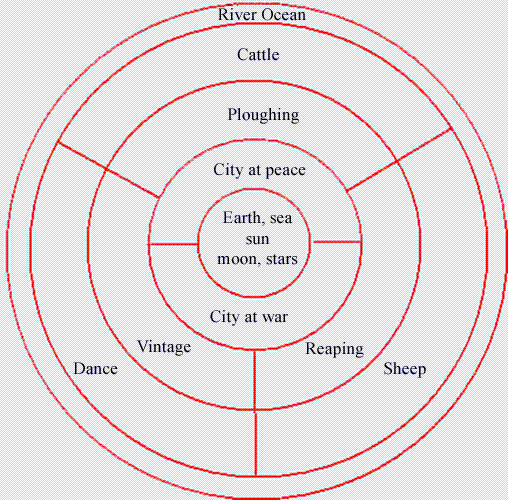
 a bronze replica of the shield as Homer describes it in Richmond Lattimore's translation of the Iliad of Homer (Chicago: University of Chicago Press, 1951). He has created a sketch similar to the diagram Malcolm  M. Willcock gives in A Companion to the Iliad (University of Chicago Press, Chicago, 1976) and has drawn the figures that will populate each round of the shield.  He plans to incise the figures in the bronze.
Diagram of the shield of Achilles as shown in Malcolm M. Willcock's work.

Monday, November 23, 2015

Pride and Prejudice

So one of my favorite examples of ekphrasis is the shield-of-Achilles passage in the Iliad. By the way, I didn't tell you in the last post, but "ekphrasis," from the ancient Greek, means to call out or draw attention to.

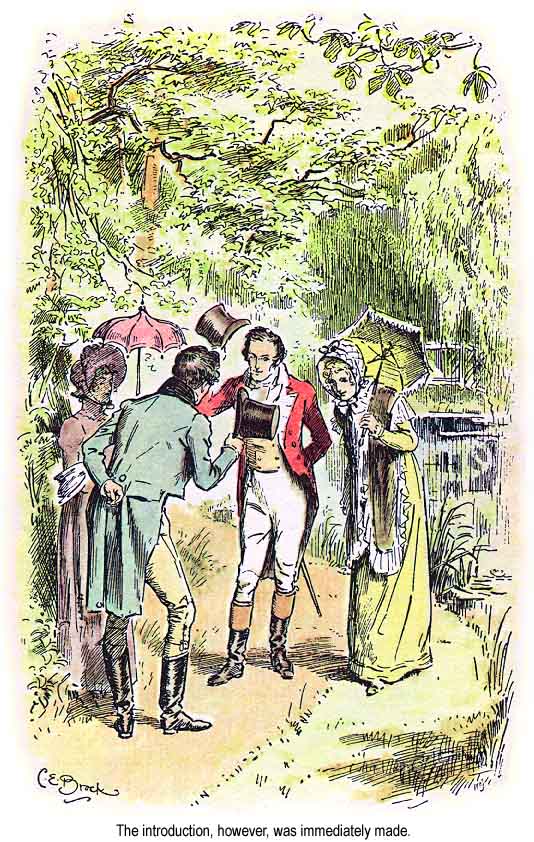
My other favorite example of ekphrasis is in Chapter 43 of Jane Austen's Pride and Prejudice. Darcy's miniature, his portrait, his gallery, his housekeeper and his sister, his home, his pond, his estate, indeed, the whole of Pemberley, show Darcy's excellent character. Entirely in his absence, his handsome, moderate, reasonable self is revealed. In the negative, as it were.

But then, in a moment of stunning drama, and to Elizabeth's great confusion, he appears unexpectedly from the outer edge of the estate. And he turns out to be as charming as his world, Pemberley, has suggested.

Elizabeth's visit to Pemberley is a turning point in the story. Elizabeth thinks with longing, in support of the satirical theme of the novel to marry well, "And of this place . . . I might have been mistress!" Elizabeth's visit is also in support of the deeper theme, of finding balance in marriage and in life, which in this case will consist in finding an excellent husband for the heroine, who by now has become our Elizabeth, and an excellent wife for Darcy.

Friday, November 13, 2015

The Shield of Achilles

"Ekphrasis" is a literary description of a beautiful object or work of art. In the greatest epic poem of Western civilization, Homer's Iliad, the shield of Achilles is the most famous and best example of ekphrasis.

Achilles's circular bronze shield depicts the cosmos in miniature in bands from the center out (Book Eighteen, lines 478 to 608). We understand from Homer's description that Achilles longs for the restoration of peace and the sweetness of everyday life, even as he takes the battlefield to restore these things to his people. (Of course, I am simplifying like crazy, and, if you think classical scholars don't argue over every one of these points, I am sorry to say that you are mistaken.)

In Homer's IliadBook Sixteen, Achilles's best friend Patroclus requests permission to lead the Myrmidons into battle wearing Achilles's armor. By disguising himself as Achilles, Patroclus hopes to surprise the enemy into stopping the fight and giving his men a break. Achilles agrees to the plan even as he himself sets aside his anger with Menelaus and so will soon return to the fight himself.

Far from calling for a temporary truce, Hector kills Patroclus, gloats over the body, puts the armor on himself, and rallies his troops around Patroclus. The Greeks and Trojans fight over the corpse all day long. At last, the Greeks take Patroclus off the battlefield and Achilles and the others spend the night in deep morning back at camp.

Achilles's armor, which had belonged to his father, is now in the enemy's hands, and so Achilles needs new armor for the duel he must engage in with Hector. Achilles' mother Thetis asks the god Hephaestus to forge this new armor. Ironically, because we are supposed to be familiar with Achilles' one weakness, his Achilles' heel, we know that when he was a baby, Thetis held him by the heel when she dipped him into the River Styx to protect him, but the heel itself, her handhold, remained un-dipped.

Look at this genius plotting! Everything that happens in the story seems to come naturally from what has gone before, even to the point of Achilles being in some measure responsible for Patroclus's death, because Patroclus was disguised as Achilles when he was killed.

The god Hephaestus (the Roman Vulcan) makes Achilles his own armor. Preparing for battle, Achilles puts on his greaves and helmet and picks up the shield, and the shield is described in a remarkable simile, in which we are once again poignantly reminded of the loveliness of ordinary life:

"Like the glow of a blazing fire from a lonely upland farm seen by sailors whom a storm drives over the plentiful deep far from their friends, so from Achilles’ splendid richly-ornamented shield the sheen rose to heaven (Book XIX in the section comprised of lines 338 to 424)."

Predictably, I guess, I cannot say everything I want to say about the shield of Achilles in one post. Let this be the start of a small series of posts.

Taken from http://aclassicaday.blogspot.com.

Tuesday, October 27, 2015

The Keystone Arch

"The Romans were the first builders in Europe, perhaps the first in the world, fully to appreciate the advantages of the arch, the vault and the dome." This statement, attributed to D.S. Robertson, author of Greek and Roman Architecture, 2nd edn., Cambridge 1943, p.231, is cited in Wikipedia's entry entitled "Arch."

Note, in this quotation, the correct use of an un-split infinitive, "fully to appreciate." Colloquially we may say, "to fully appreciate," but, if we have old-school training ("never split an infinitive"), we remember, somewhere in the back of our mind, that this usage is often seen as incorrect.

So, moving on.

A post-and-beam span, that is, an opening framed by two posts with a beam across the top, supports itself by distributing the weight of gravity from the center of the beam to the two sides and down the posts.

The keystone arch cannot support itself until the keystone, the wedge-shaped puzzle piece at the apex, is put into place. The arch is first built on top of a framework, called a "centering." The centering is removed when the arch becomes a true compression form with the placement of the keystone.

The arch supports itself by distributing the weight of gravity from the wedge-shaped keystone to the next wedge-shaped voussoir and the next, on down to the springers at the spring line. The spring line is defined by the two points at the base of the arch and the theoretical center point, "drawn" from the two lower points of the keystone and crossing at the spring line. The springers have trapezoidal tops and level bottoms to continue spreading the weight of gravity down the posts.

We have an example of an early keystone arch in the northern gate, one of seven, in the walls encircling Perugia, the capitol city of Umbria. The walls were built of limestone block between 600 and 300 BCE to protect the city from the enemy, Rome, about a hundred miles away.

The original settlers of Perugia, or in Latin, Perusia, were the Umbri, an ancient--and perhaps the most ancient--tribe in Italy.  They spoke Umbrian, an Italic language related to Latin and Oscan. But their neighbors in Etruria, the Etruscans, spoke an unrelated language, which some scholars now believe may be a Tyrsenian language like the Raetic language of the Alps and the Lemnian language of Lemnos.

By the time the Roman general Fabius Maximus Rullianus led a successful expedition against Perugia in 310 or 309 BCE, the Umbrians had intermingled with the Etruscans and Perugia counted itself as one of the twelve cities of the Etruscan League. According to Livy, our source in this matter, the Perugians lost the battle and were accorded a thirty-year truce with Rome.

In a rebellious move, Perugia took part in the Second Samnite War against Rome in 295 BCE and had to renegotiate the treaty. By 216 and 205 BCE, the city found it prudent to help Rome in the Second Punic War.

Then the city fell a third time, when Mark Antony's younger brother and supporter Lucius sought refuge there in 40 BCE. Octavian, the future emperor Augustus, besieged the city and Lucius was compelled to surrender. The city was burned to the ground, but, based on archaeological evidence, rebuilding began almost immediately.

Soon thereafter, as part of a public-works program, Octavian repaired the wall and the ancient northern gate of Perugia, whose Umbrian or Etruscan name, as far as I can tell, we do not know. He rebuilt the keystone arch that the Perugians had originally built and this gate soon became known as the Augustan Gate, Porta d'Augusta.

So, as they often did, the Romans adopted the keystone arch from the people they conquered and used it widely in bridges and aqueducts, triumphal arches and gates, vaults and domes.

Tuesday, October 13, 2015

Keystone Cops (or Kops)

The Keystone Cops starred in silent movies made by Canadian-born and American-based director and actor Mack Sennett (1880-1960) between 1912 and 1917. Sennett's company in 1912 was called Keystone Pictures Studio; hence, "Keystone Cops."

Slapstick--humor involving someone who, by his or her own clumsiness or ineptitude, becomes the butt of the joke--is as old as comedy. Someone on stage or film slips on a banana peel or takes a custard pie in the face or gets a whack on the rear end and we laugh uproariously. If we have gone out of our way to refine our sensibilities, we laugh uproariously, but still feel bad about making fun of our hapless victim.

The term "slapstick" comes from the battachio of Italian Commedia dell'Arte, a wooden prop of two slats held together at one end so that when one player smacks another player, the battachio makes a loud noise that sounds like it hurts, but does not.

To show slapstick in movies, Sennett used some special effects. He filmed at slow speed so that the action looked faster than it was, and he had every fourth frame of film edited out so that the action looked jerky. I ran into a YouTube clip of a remastered Sennett film, which remastering in part involved fixing filming speed. But if these editors took out Sennett's special effects, I'm thinking that Sennett would not have wanted fixes like that.

In the Keystone-Cop version of slapstick, uniformed policemen chase a bad guy, but instead of calm thinking, quick action, and speedy resolution, they run off in all directions in disarray. The Keystone Cops first appeared in a comedy short, Hoffmeyer's Legacy, 1912 and became popular after their appearance in another short, the Bangville Police, 1913. Starting 1914, they no longer played starring roles, but became a background troupe for Charlie Chaplin and other silent-film stars.We know the names of the actors who played the first Keystone Cops, but the cast changed from movie to movie.

Here is the logo for Sennett's company in 1912:


As for the significance of the keystone in the logo, I will take that up in a later post. For now, let me just remark that Sennett probably chose "keystone" because it is a weighty term from classical architecture. The keystone is the final piece that allows a keystone arch to stand alone, without the scaffolding needed to construct it.

Monday, October 5, 2015

OCD (Obsessive Compulsive Disorder)

First, a joke, told by my friend Beth:

"I have CDO."

"What's that?"

"OCD with the letters in the right order."

The other day I was working on creating a bad-guy character for the thriller I'm writing. The story is set in 1952. I decided to make Del read every piece of writing that came his way, which is something I find myself doing. As if he, and I, could put together the meaning of the universe by assembling a complete book of these scraps.

For example, here is Del before he assassinates one of our heroes:

In the bathroom, he filled the hotel glass with tap water and dropped in two Alka-Seltzer tablets. “Keep tightly closed in a cool, dry place,” admonished the label on the bottle. When the drink had almost stopped fizzing, he chugged it down. Maybe that would take the edge off this hangover. 

He shaved, showered, parted and combed his hair, and put on a suit and tie.

Some breakfast couldn’t hurt either, he thought.

He went downstairs to the hotel restaurant and sat in a red leatherette booth at the window looking onto the street.

His waitress, “Dodie,” according to her nameplate, came over with the menu and the coffee pot. He turned over his coffee cup so that she could fill it for him. On the bottom of the cup, it said, “Buffalo China.”

Dodie poured his coffee. “What can I get for you, sir?” she said.

He looked at the menu. “I’ll have two eggs over easy, two pieces of buttered white toast, hash browns, sausage links.” He kept the menu so that he could read the whole thing while he ate.

Dodie brought his breakfast, kept his coffee cup full, and without a word replaced the heavy white napkin—embroidered in blue with the words “Colonial Inn”—that he had dropped.

And, after the assassination:

Now it was time to call Chaz and let him know that General Brink was dead, the fixers could clean up his office, and the Pentagon press staff could release their version of the story.

He dialed nine to get outside the hotel switchboard and then zero to get a telephone operator.

“I want to place a long-distance call to Saigon, the U.S. Embassy. I’m calling for Chaz Darnell.”

“Yes, sir. I’ll put you through.”

He lit a Lucky Strike. He listened to a succession of clicking noises as operators connected him from Washington, D.C. to Los Angeles, Los Angeles to Honolulu, Honolulu to Saigon. He picked up the first cigarette from the ashtray and lit another one from the first.

He idly read the package. “Lucky Strike—It’s Toasted—Cigarettes.” He always bought himself a couple of packs of Lucky Strikes when he visited the states. These cigarettes were so much milder than the cigarettes he could get in Saigon.

“Chaz Darnell here.”

“It’s Del.”

“Hail the conquering hero!”

“It’s done.”

“I’ll take care of everything else, then.”

Maybe I've reached a sort of pact with my own quirks and oddities. My new motto: make my own idiosyncrasies work for me.


Saturday, September 12, 2015

Zero

Leonardo Bonacci (c. 1170 to c. 1250) also known as Fibonacci (or Filius--son of--Bonacci), was an Italian medieval mathematician. First, he introduced Arabic (originally Indian) numerals to the West. Second, he described the "Fibonacci number sequence," a beautiful and naturally-occurring spiral progression found in shells and flowers, even galaxies, and reproduced by artists from ancient Greek to post-modern as an ideal of proportion, the Golden Mean.

In 1202, Fibonacci published Liber Abaci (Book of Calculation), the first section of which introduces the Hindu–Arabic numeral system that he had encountered in the North African city, Bejaia. He tells us that the numerals 1, 2, 3, 4, 5, 6, 7, 8, and 9 come to us by way of India. The sign 0, he says, which "the Arabs call zephyr," صِفْر ‎(ṣifr, “nothing, cipher”), was originally śūnya in Sanskrit: शून्य.

Disclaimer: the first time I learned about the Fibonacci sequence was on February 25, 2005, when I watched the first season, sixth episode, "Sabotage" of a TV show called Numb3rs. Consider yourself  warned: I "understand" math, in a wordy sort of way, and I love the concepts, but I am not a mathematician. I hope you will check out this page about the Numb3rs episode, in which Charlie, the math-geek hero, explains more about the Fibonacci sequence.

If you had to learn to read and write Roman numerals, and, as a proponent of Western culture I really hope you did, you can imagine how difficult it would be to perform simple mathematical operations like addition and multiplication without the concept of zero or the idea of a numeral for a place-holder with no value of its own.

The first known English use of the word zero was in 1598, from French zéro, Italian zero (a contraction of zefiro), and Old Spanish cefr.

I promise nothing, but, in my research, I have run into a book by Charles Seife, Zero: The Biography of a Dangerous Idea (Viking, 2000) and a Scientific American article, "The Origin of Zero," by John Matson, August 21, 2009.