Wednesday, August 27, 2014

Archaeology Best Sellers, In Three Parts. Part 1: Connolly

Every once in a while, I read a popularized archaeology book that catches my eye. Lately, for example, I've made my way through The Parthenon Enigma, by Joan Breton Connolly (New York: Knopf, 2014); The Secret of the Great Pyramid, by Bob Brier (New York: Harper Perennial, 2009); and 1177 B.C.: The Year Civilization Collapsed, by Eric H. Cline (Princeton: Princeton University Press, 2014).

And I mean "made my way." Except for the dramatic, thriller-style titles, these books, although well-reasoned, are not well-written. They are scholarly works, complete with heavy words and plodding arguments, dressed up as best sellers.

Maybe these works can get away with looking like--yes, even acting like--best sellers, because their main ideas are so great.

In the Parthenon Enigma, Connolly argues that the Parthenon frieze "tells" the founding myth of Athens, in which Athens's first king, Erechtheus, sacrifices his daughter to save the city. We had lost track, not of the myth itself but of its importance, until we recently recovered a play by Euripides that tells the tale.

Connolly debunks the idea that the frieze shows the procession of the Panathenaea, the great annual festival of the city, which is how we had been used to interpret the frieze.

As part of her argument, Connolly depicts all ninety-two marble metopes, or panels carved in bas-relief, from the Parthenon frieze. (In a typical Doric frieze such as this, metopes alternate with triglyphs, carved marble panels with three vertical lines, perhaps memorializing the beam ends of  ancient wooden structures.)

The British Museum holds most of the metopes as part of the Elgin Marbles. The new Parthenon Gallery of the Acropolis Museum and six other institutions hold the rest.

Connolly remarks that part of the problem in the misinterpretation of the frieze lies with the loss of Euripides's tragedy and part with the diaspora of the marbles themselves. Scholars could have looked at them as a single narrative, but, having to work with the same limitations as the rest of us human beings, they did not.
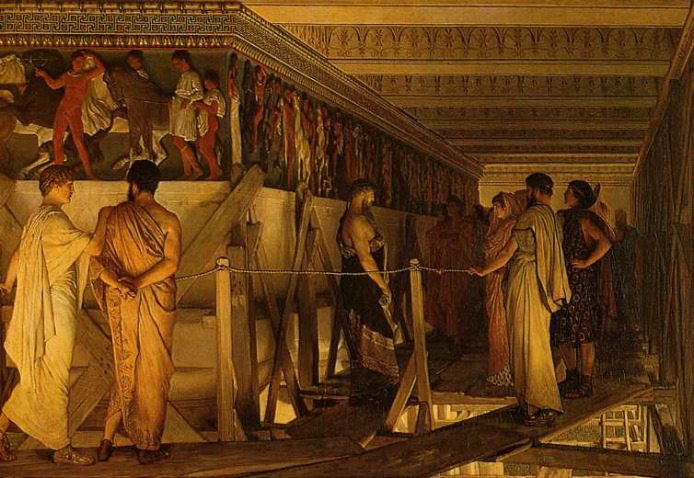

Phidias Showing the Frieze of the Parthenon to his Friends, by Sir Lawrence Alma-Tadema, 1868, held by Birmingham Museums And Art Gallery. 

Part 2: Brier.
Part 3: Cline.

Tuesday, August 19, 2014

Return to Casino Royale

In On Her Majesty's Secret Service, James Bond returns to Royale-les-Eaux to visit the grave of Vesper Lynd, a yearly pilgrimage of his. On the road, he and the mysterious, and reckless, Contessa Teresa "Tracy" di Vicenzo race each other in their cars. Later they meet face to face in the casino, where Bond, even though he barely knows her, covers her gambling debt to save her from a dishonorable loss, un coup de deshonneur.

But Tracy is worse than reckless; she is suicidal. The next day, Bond interrupts her while she is trying to kill herself.

Bond finds himself talking alone to Tracy's father, Marc-Ange Draco, head of the Corsican Mafia and holder of the King's Medal for Resistance Fighters (so, even though a criminal, a good guy). Draco convinces Bond to make love to his daughter, to give her hope enough to stay alive, and admonishes him to keep their conversation herkos odonton, which, he says, is Greek for top secret.

Now according to Hank Prunckun, in Counterintelligence Theory and Practice, this Greek saying probably comes from a passage in the Odyssey in which Zeus asks Athena to be careful about letting information slip so easily through the barrier (herkos) of her teeth (odonton).

I am easily amused, and I have been having fun imagining the school boy, Ian Fleming, coming across this phrase and tucking it away in his mind. "Someday," he thinks, "I'll find a use for this wonderful phrase, herkos odonton; I just know I will."


Tuesday, August 12, 2014

Casino Royale

The time has come, I'll wager, for an annotated edition of Casino Royale (first published in London by Jonathan Cape Ltd in 1953).

Case in point:

Bond is at the roulette table. He has lost the money his government bankrolled him so that he could clean out the villain, Le Chiffre. He is despondent, with nowhere to turn. What can he do now?

His American spy friend, Felix Leiter, slips him a new stake, an envelope full of cash, and says, "Marshall Aid. Thirty-two million francs. With the compliments of the USA."

Note:

After the devastation of World War II, Europe struggled to rebuild. The Marshall Plan, named for Secretary of State George Marshall, provided $13 billion in economic grants and loans to the United Kingdom, France, and other European nations, including enemy combatants, Austria, Italy, and West Germany, over a four-year period from 1948 to 1951. The idea was that the slow start of economic regrowth in postwar Europe could make countries vulnerable to Soviet Communism and a little stimulus could help prevent this.

So Felix is joking with Bond. Just as the United States provided economic stimulus to Europe, so Felix helps Bond with the money he needs to beat Le Chiffre.

Monday, July 28, 2014

What Is a Sabretache?

James Bond is in Royale-les-Eaux, a fictional fishing village on the coast of Britanny. Royale-les-Eaux was twice a fashionable health spa, once during the Second Empire and again at the turn of the nineteenth century. Now, in the early 1950s, it is a gambler's paradise, where the worldly can play baccarat and other games of chance at the Casino Royale.

Bond is meeting Mathis, his MI6 contact, over lunch at the Hermitage. Mathis will introduce him to Mlle. Vesper Lynd, the woman who will help him in the operation to bankrupt Le Chiffre.

At this first meeting, the beautiful Lynd wears a grey silk dress with a square neck, tight bodice, and slightly full skirt; her waist is encircled by a black, 3-inch-wide, hand-stitched belt. (The dress is by Dior, as it turns out.) Her shoes are a matching black and her hat, a large "cart-wheel" of gold straw, has a black ribbon. Around her neck, a gold flat-link chain lights up her sun-tanned skin; on her finger, a "broad" topaz ring picks up the gold of the necklace and the straw hat.

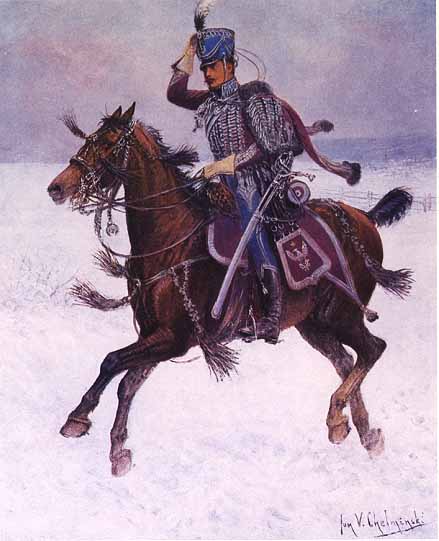
Her purse is a black, hand-stitched sabretache, a military pouch once carried by Magyar horsemen of the tenth century; we have examples of these pouches as grave goods. Then called a tarsoly, the pouch was suspended from the belt with the saber and so hung under the saber and to the rider's left side. It was often embellished with a coat of arms or monogram on the front flap.

Hussar cavalry soldiers adopted the tarsoly, in part because their uniforms were so tight that there was no room for pockets, but changed the name: German sabel for saber plus tasche for pocket became sabretache.

British cavalry in the Crimean War (1853-1856) still carried sabretaches. According to the Wikipedia entry, "'undress' versions in plain black patent leather were used on active duty."

So to complete the picture of Miss Lynd, this is how I see her sabretache: it is plain, but shiny, black patent leather like those British cavalrymen used in the Crimea.

A Hussar officer in full dress, army of the Duchy of Warsaw in 1807. His sabretache is emblazoned with the White Eagle of Poland. Painting by Jan Chełmiński, 1913.

Wednesday, July 23, 2014

Athena's Little Owl

Athena, Greek goddess of wisdom, has protected the city of Athens for 7,000 years, the first settlers having occupied the Acropolis in the Neolithic age. And she always hangs out with her Little Owl (Athene noctua), who prefers to nest in nooks and crannies and has likewise frequented the Acropolis since prehistoric times.

The city-state of Athens minted the first silver owl around 526 BCE, near the end of the Archaic Era. The coin was a tetradrachm, about seventeen grams of silver worth four drachms or about four days' labor.

That's a lot of money. Typically you would spend obols or drachms on everyday items; you would spend any owls you might accumulate on luxuries like jewelry or horses or you might save them.

Unlike earlier coins, Athenian owls had a head and a tail: Athena's head was on the obverse and her companion and emissary, the Little Owl, on the reverse.

Silver bullion for the owls came from Laurium, a village thirty-seven miles to the southwest on the Aegean, where ten thousand or more slaves extracted around a thousand talents a year (with one Attic talent equal to 26 kg or 57 lb). Athens owned the mines and rented out some of the mining rights for a percentage of the production.

At the mint in Athens, in a kind of ancient production line, slaves heated the silver in an oven and molded pieces (or flans) by weight. Other slaves carved dies, from bronze or iron, with the image to be imprinted on the coin in the negative. So, for the owl, the carvers hollowed out Athena's helmeted head, in profile, on the obverse die and the Little Owl in three-quarters view with the head turned full front on the reverse die. And other slaves still struck the coins, one at a time, by "sandwiching" hot flans between dies, hitting them with a mallet, and tossing them into a vat of water to cool.

Now in 483 BCE, seven years after the Greeks had turned back the Persians at Marathon, a rich new lode of silver came to light at Laurium. Herodotus (484 to 425 BCE), whom we used to call the "Father of History" when I was in school, tells the story: Themistocles convinced the Athenians to use the money for defense, to build warships, in case the Persians mounted another invasion.

Which, as it happens, they did, in 480 BCE. Only through the exceptional valor of Leonidas and his Spartan 300 were the Persians delayed, at the Battle of Thermopylae, on their way to destroy Athens. For Xerxes, son of the first invader Darius, was as intent as his father on punishing Athens for its part in inciting rebellion in the Ionic colonies in Asia Minor.

Fortunately, the Athenians had time to prepare for the attack, at least to some extent. One citizen buried his owls and other treasures on the Acropolis, and we did not discover his hoard, in the burn layer dated to this event, until 1886.

So the Athenians went to Salamis and witnessed the sea-battle between the Greeks, in warships paid for with owls, and the Persians. The Greeks won, and Xerxes returned to Persia, leaving one of his generals in charge of the conquest of Greece. That general was beaten at the Battle of Plataea a year later.

The Athenians treated the damage to the Acropolis as a "lest we forget" monument and did not start rebuilding until 447 BCE, when Pericles began his building program that included the Parthenon (constructed under the supervision of Phidias from 447 to 432 BCE) and the new Athenian mint, put up in the Agora in 430 BCE. The new public buildings were paid for with owls.

An ancient Athenian "owl," or tetradrachm, about seventeen grams of silver, circa 480 to 420 BCE. Held by the Museum of  Fine Arts, Lyon. In daily use, the Athenian drachmas were called glaukes (γλαῦκες, owls).

Marie-Lan Nguyen, CC by 2.5. Uploaded by Jastrow.

Sunday, July 13, 2014

Trajan's Column

Here at Small Talk, I've been having technical difficulties.

Translation: I determined that the charger for my computer was bad. Discovered that it was just too inconvenient to write a post on my so-called smart phone. Refused to pay $80.00 for a new charger from the computer manufacturer. Ordered a knockoff from China. Received my new charger and discovered that it worked.

Each of these tasks managed to eat up one week of my life.

During the downtime, I kept notes (on my so-called smart phone) about posts I was planning to write as soon as the technology caught up with me, if such a thing is possible, and especially on a Roman battle formation called the turtle (testudo).

For the testudo, a small group of legionaries raises their shields (scuta in Latin) so that the front and top, sides and back, of the squad are protected from projectiles, with the shields covering it like roof tiles.

So the turtle has two primary purposes. One, it can defend against arrows shot by a company of archers on the battlefield. Two, it can shelter against missiles thrown from the walls of a besieged city while the squad digs under the foundation or otherwise tries to break in.

Although the shields are not too heavy to lift and hold--each shield weighs about twenty-two pounds--the formation is unwieldy, because the men in essence overlap shields and move or stay as a unit. The formation can also prove unsuccessful: if positioned directly under a wall from which heavy objects are being dropped, the men can be summarily wiped out, and we have a record of this having happened.

There is a striking image of Roman legionaries in the testudo formation on Trajan's column during the siege of Sarmisegetusa in the second Dacian war (106 CE). (Sarmisegetusa was in what is now Romania.)

I reckon that this turtle is made up of sixteen shields. So I am going to provide a video, if you will, of this snapshot, based on my research into the Roman army at this time.

The senior chief (decanus) yells, "Form the turtle! (Testudinem facites!).

The other chief and both squads, each composed of seven tent-mates (contubernales), smartly raise their shields.

Other legionaries, probably not the men keeping their shields up, begin hacking at the water pipes that bring water into Sarmisegetusa.

This tactic ultimately brings victory. When the Roman army threatens to torch the city, Sarmisegetusa must surrender.

The testudo, or turtle, formation, shown on Trajan's column.

Cristian Chirita. CC by SA3.0.

Monday, May 12, 2014

Bookworm

The first time someone called me a bookworm, I was a little girl, but I sensed that the word was pejorative.

The word was coined in 1599 by Ben Jonson in a now all-but-forgotten play called Cynthia's Revels. (Well, not completely forgotten; you can find it online.) The play was first performed in 1600 and published in 1601.

"Heart," remarks Hedon to Anaides about the scholar passing by, "was there ever so prosperous an invention thus unluckily perverted, and spoyl'd by a Whore-son, Book-worm, a Candle-waster?" (Cynthia's Revels, III, ii.)

The hyphen in Book-worm, denoting that two words are being coupled in an unusual way, had been dropped by 1855, when Mrs. Gatty finally used the word to refer not to a reader who was also a dreamer but to the anolium beetle and other pests who feed on tasty parts of books.

Here you will find a painting of a man-after-my-own-heart bookworm by Carl Spitzweg.

In passing, let me remark that the now-defunct hyphen in a compound word like bookworm or email causes editors to rip out their ever-greying hair, to hold the line unbecomingly, or to give way to the new while some measure of grace is still possible.

The Bookworm, by Carl Spitzweg, 1850. Held by Museum Georg Schäfer in Schweinfurt, Germany.

Uploaded by Iryna Harpy to Wikimedia Commons.