Wednesday, May 30, 2018

Horst in Dresden

Lately, on a Sunday morning, I went down to the Starbucks inside the Safeway near me, and an old man (I am about to be 72, so I mean really old; I guess he was in his eighties) asked if he could sit at my table with me. I said yes, and, contrary to what I usually do in such situations--I am not trying to pick up men in coffee shops--I started talking to him.

First I noticed that he had a European accent, so I asked him what his native language was. German.

Next I said I was reading a book about World War II (I forget which one now, most likely fiction). He said he didn't have to read about it, he was in it, and that was enough for him.

Turns out he was a boy in Dresden when the British and American Allies bombed the city in four different raids between February 13 and 15, 1945, killing an estimated 22,700 to 25,000 people. 

My coffee-shop acquaintance was not outside during the bombing, but his younger brother, whose name I don't know, and his older brother Horst, were. Horst was killed, his parents had to bury what little of him they could find, and Horst's foot, still in his boot, was not found until a week later.

When the younger brother went back to the house, his mother asked him where Horst was, and the boy said, "Dead, I guess." My acquaintance used this as an example of how inured people get to  violence around them during wartime.

Of course, the bombing became controversial in 1953, and my acquaintance, who emigrated to the United States as a boy or young man, had probably already come to this country. While the people analyzing the command decisions of the Allied military said that the bombing was a strategic necessity, critics said that the city of Dresden was not an important target and, as a historic and cultural treasure trove of European civilization, should have been spared. 

Sunday, February 4, 2018

War Stories

I kind of collect World War II stories that I run across or that people tell me about.

First, my own family's. My dad flew a TBF Grumman Avenger torpedo bomber with squadron VT-15 off the USS Essex in the Battle of Leyte Gulf, October 23-26, 1944. This battle was the largest naval battle of World War II and maybe the largest naval battle of all time.

By his actions and those of his mates, Japan "lost four aircraft carriers, three battleships, six heavy and four light cruisers, and eleven destroyers," according to the Wikipedia article, Battle of Leyte Gulf. For his actions in battle, he and his entire squadron were awarded the Navy Cross.

He shipped home soon after V-J (Victory over Japan) day, so in the case of the Navy discharging personnel, this would have to be September 2, 1945, Japan's signing of the surrender document, when World War II in the Pacific ended.

I was born about nine months later, on June 1, 1946.

My dad was a small-town boy raised in Santa Barbara and he went on to matriculate at the University of  California, Santa Barbara, and, later, Berkeley, graduating in 1942. Then he enlisted in the Navy and became a pilot, fulfilling a life-long dream. Family legend has it that, when he was a little boy, his mother had to arrange his string beans into an airplane shape before he would eat them.

In later years, he saved his Navy Cross, but felt ambivalent about it, because it was a reminder of how many people he had killed. The only other thing I know about that he saved from the war, besides a stray ribbon bar or two, was his map of the Pacific on a silk scarf, which airmen carried in case the plane went down.

But he suffered from what we now know as PTSD (Post-Traumatic Stress Disorder) until he died young of a household accident in 1970.


Tuesday, January 9, 2018

Blizzard

My plan was to write a post on the word "snow" (done) and then maybe do a series of posts on related words: "blizzard," "ice," "winter," and so on. But, as you may know by now, my plans "gang aft agley," and, in this case, that is because the etymology of "blizzard" is somewhat unclear and I spent some time trying to figure out how to write this up.

One thing we're pretty sure of is that "blizzard" is an American, not English, word. And, we're not certain, but it may be onomatopoetic (favorite word of newby English students), which just means that the word sounds like what it describes. So a bee makes a buzzing sound as it flies from flower to flower, and a blizzard makes a "blizzing" sound as high winds and snows lash the prairie.

A blizzard, as defined by the National Weather Service, is "a severe snowstorm characterized by strong winds causing blowing snow that results in low visibilities," or, as I would amend it, "low visibility," and helpfully adds: "The difference between a blizzard and a snowstorm is the strength of the wind, not the amount of snow."

Now, in my opinion, this definition could be clearer. "Blizzard" is defined as a "severe snowstorm," but, if you look up "snowstorm"in the National Weather Service Glossary, that word is not listed at all. A dead end. The kind of dead end a word nerd hates most of all.

At any rate, the Oxford English Dictionary claims that, although the word had appeared in print earlier from time to time, "blizzard" came into currency in the Dakota Territory during the winter of 1880-1881. O. C. Bates, of the Estherville, Iowa, Northern Vindicator newspaper, used the word "blizzard" on 23 April 1870 to describe the harsh snowstorms of that fall and winter.

Now we hit the jackpot. The winter of 1880-1881 is the long winter described by Laura Ingalls Wilder in her book of the same name, written in the 1930s and published in 1940. She uses the word "blizzard."

At the Big Slough on his farm, Pa observes that the muskrats have built the walls of their den extra thick and, soon after, at the general store in town, he encounters a Native American (or "Indian," as Pa calls him) who has come into town to warn the settlers of the impending harsh winter.

Pa decides to move his family into town, and it's a good thing, too. According to information in the National Archives, Eliza Jane Wilder moved to the town with her family, including her younger brother, Almanzo, who would become Laura's husband, and she reported that many families froze to death that winter.

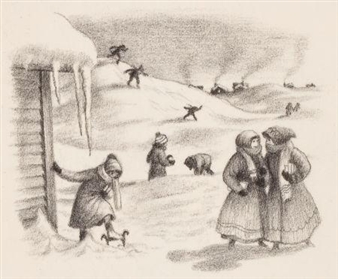
One of Garth Williams's illustrations from the Long Winter.


Saturday, December 16, 2017

Snow

Occasionally scraps of great poems pop into my head, seemingly at random: "Lhude sing cuccu," for instance, or "Whan that Aprille with his shores soote/The droghte of Marche hath perced to the roote," or, lately, "Mais où sont les neiges d'antan?"

Nothing wonderful about that, except for how much I enjoy the rags and tatters left to me. These are some of the most famous lines in English and French literature.

And when I investigated the Villon line, "Mais où sont . . . ," I discovered that I would have heard it most recently when the dowager countess quotes this line to Mary, in French, during Downton Abbey's 2015 Christmas Special and series finale. She is consoling Mary about her lost love, and remembering a great lost love from her own past.

"Hmm," I thought, our word "snows" doesn't seem to have much in common with "neiges" or other Romance language words for snows, "nevi" (Italian), "nieve" (Spanish), "neves" (Portuguese). So, I wondered, are the words "snows" and "neiges" related or not?

Happens they are, and the link is hinted at in the German word for snow, "schnee."

According to the Wikipedia entry for snow, the word is from "Middle English snow, snaw, from Old English snāw (“snow”)" and is "cognate with Scots shaw ('snow'), West Frisian sine ('snow'), Dutch sneeuw ('snow')," and so on.

What can I say? Sometimes we word nerds just get to go all out.

Tuesday, November 7, 2017

Richard II and the First Angel Roof

Westminster Hall is the oldest surviving building of Westminster Palace. Once used for feasts, coronations, and, ironically, the deposition of King Richard II, it is now the meeting place of the British Parliament. The palace is in central London, on the north bank of the Thames River.

If you've visited Westminster Hall, you've gazed up at the beautiful late Gothic ceiling that looks a little bit like heaven, the first angel roof. In 1397, master carpenter Hugh Herland (ca. 1330-1411), working in oak, designed this angel roof for Richard II as part of a remodeling project.

The purpose of the remodeling was twofold. First, replace the original closed roof trusses with open trusses, making the space look bigger without changing to its volume. The ceiling spans more than 68 feet in all, but is now open in the center for over twenty-five feet of the span, from the end of one hammer beam to the other.

Second, populate this new heaven with angels in honor of Richard II (1367-1400). Carved wooden angel sculptures decorate the hammer beams and appear to be hovering between heaven and earth.

Richard II used the iconography of the angel to help support his ideas about the divine right of kings, a fact to which Shakespeare alludes in his play Richard II. In Act 3, Scene 2, the king says,

For every man that Bolingbroke hath press'd
To lift shrewd steel against our golden crown,
God for his Richard hath in heavenly pay
A glorious angel: then, if angels fight,
Weak men must fall, for heaven still guards the right.

In 1377, during his coronation procession from the Tower of London to Westminster Hall in 1377, Richard accepted his crown from a mechanical angel (Richard II, The Art of Kingship, ed. by Anthony Goodman and James Gillespie, London: Clarenden Books, 1999).

In 1392, at the procession marking his reconciliation with the City of London, Richard again received his crown from a mechanical angel, as an eyewitness reports: “At his entry into Cheapside ... came two angels down from a cloud, the one bearing a crown for the king...and the other another crown, which was presented to the queen . . . ."

On September 30, 1399, Richard laid aside his crown in Westminster Hall in favor of the upstart, Bolingbroke, now King Henry IV.


Westminster Hall in the Palace of Westminster, London as drawn by Thomas Rowlandson and Augustus Pugin for Ackermann's ''Microcosm of London'' (1808-11).

Thursday, September 14, 2017

Style Sheet Revisited

Writing, editing, and proofreading are as much a part of me as my fingernails. I write, edit, and proof, as part of the way my mind works. I can hardly help myself.

You would think, then, that, on beginning a blog, especially one about words, I would have started a style sheet first thing: just a few notes on how I handle things that come up all the time. Pretty much all publishing houses, newspapers, and corporations keep them to maintain consistency from one document to the next.

For instance, I use and firmly believe in the serial comma. With the serial comma, the reader--final arbiter of clarity--never has to stop and think about meaning. In this obviously English example from the Guardian Style Guide (cited in the Wikipedia entry on the comma), "he ate cereal, kippers, bacon, eggs, toast and marmalade, and tea," the reader is not tripped up wondering whether he ate toast and marmalade or whether he actually ate toast and, separately, swallowed a spoonful of marmalade as if to disguise the taste of a bitter pill.

However, if you had assumed that I started a style sheet as a matter of course, you would have been overestimating me. About twenty-five posts in, I started keeping some notes on the back of a #10 envelope, which became a bookmark for a while and then drifted off into the stacks of printouts, bills, to-do lists, and other papers at my house.

Now, some 82 posts in, I bemoan my lack of methodical approach and think, every once in a while, that I have to go back and reread every post and come up with that style sheet, just for my own sanity. I can never remember whether I italicize words as words or put quotation marks around them; how I cite a book or article I am using heavily; or any of the other small matters that niggle at a writer's mind.

My father's mind worked much the same way mine does, and, from his position as a college professor of sociology, he corrected his students' papers like an English teacher. Once, as a kid, I asked him why the sign in a shop window had a misspelling on it. Not realizing that many people do not have his and my gift (or curse) for language, his answer was: "That's so you'll go inside the shop and tell the people inside that the word is spelled wrong."


Tuesday, April 19, 2016

The Sword in the Stone and Excalibur

The Matter of Britain, the body of medieval literature about King Arthur and his knights of the round table, is vast, and scholars spend their whole lives studying it. I am no expert; anything but. I am just a student of literature who loves a good story. Even better, a collection of stories that come together in a complex and imaginative way.

Sir Thomas Malory published the Morte d'Arthur in 1485. This book combines all the threads of the story that came before and becomes the source for our modern-day versions, including Howard Pyle's Story of King Arthur and his Knights (1903), T. H. White's Sword in the Stone (1938), and Marion Zimmer Bradley's Mists of Avalon (1983).

My question is, when did the sword in the stone come into the story? And is the sword in the stone Excalibur?

The sword Excalibur, or Caledfwlch in the original Welsh, is part of the earliest Welsh legends about King Arthur. Excalibur is a compound of two Welsh words, meaning hard and breach or cleft. By the time Malory publishes, he says that Excalibur means "cut steel," a nice take on the original etymology.

From the Old French prose cycle of Arthurian literature, the Lancelot-Grail (dating from 1210 to 1230 or so), Malory gets the element of the Lady of the Lake, who hands Excalibur to King Arthur. (The Lancelot-Grail material adds other elements we consider crucial as well, including Lancelot's adulterous love affair with Guinevere and his quest for the Holy Grail.)

And from Robert de Boron's Merlin, published around 1450, Malory gets the sword in the stone and the gist of its inscription, "Whoso pulleth out this sword of this stone and anvil is rightwise king born of all England." De Boron states that the sword in the stone is not Excaliber.

In the de Boron work, the fifteen-year-old Arthur, heir to the late king Uther Pendragon but in disguise as the foster son of a nobleman, pulls the sword as a stand-in for the blade his foster brother Sir Kay forgot at home. And, because he is a generous boy and humble to a fault, he lets Sir Kay take credit for the deed. Sir Kay's father calls him on the lie and Sir Kay has the opportunity to confess his sin, repent, and return to God's grace.

In later tellings, and maybe because Malory includes the sword in the stone and Excalibur without reconciling the two, as it were, the swords can be mixed up with each other.

Monday, March 7, 2016

The Saxons

Ptolemy (ca. 100-ca. 170 CE) was a Greco-Egyption citizen of the Roman Empire who lived and died in Alexandria. One of his most influential works was the Geographia, published, we think, around 150 CE. The book was written in Greek, lost during the Dark Ages, and translated into Arabic in the 9th century and into Latin in 1406.

Just to show you how influential Ptolemy's book was, let me mention in passing that Christopher Columbus was using revisions of Ptolemy's maps when he sailed to the New World, which he thought was India.

At any rate, the first mention we have of the group of Germanic tribes called "Saxons"--in Latin, saxones--is in Ptolemy. He places them as a group of Germanic tribes living near the North Sea coast of what is now Germany.

People who study etymology in depth surmise that the Saxons' name came from the Old English word for the kind of knife the Saxons used, the seax. The seax typically has a long, single-edged blade with a tang forged on the centerline of the blade and then enclosed in a handle of wood or horn.  Its name is thought to come from a Common Germanic root, *sah, *sag,"to cut."

And there is more!

The disparaging Scottish Gaelic word "sassenach," by which pet name Jamie often calls his wife Claire, in the Outlander series of books and now TV shows, means "outsider," literally Saxon or English.

Tuesday, December 15, 2015

The Shield of Achilles--Again!

Many artists have created their own image of the shield of Achilles so that we can see it the way Homer did and understand its meaning in the Iliad. We are also to understand, I think, that the shield belongs with us now as much as it did twenty-seven-hundred and some years ago.

W. H. Auden, in his poem "Shield of Achilles," gives us a glimpse of the armor of an immortal Achaean hero going to his destiny and compares him with our latter-day anti-heroes. (On this theme, I highly recommend the graphic novel, Watchmen, by Alan Moore and Dave Gibbons. New York: Warner Books, 1987.)

Cy Twombly, in his painting Shield of Achilles, shows us the passion that drove Achilles to absent himself from the fight as well as the resolution that led him to return. Now he can take up the battle and triumph over Hector.

And my friend Todd, reference librarian, artist, and Bronze-Age reenactor, will soon present us with a
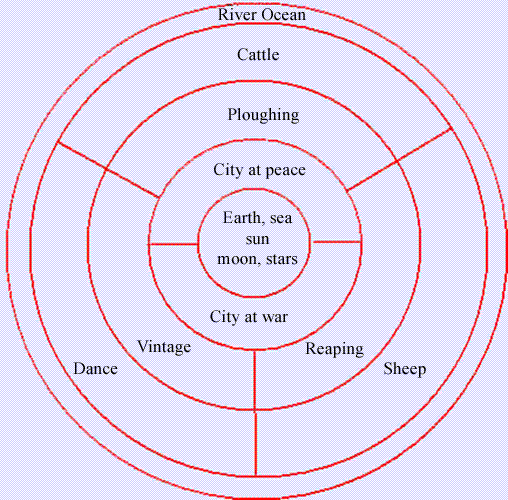
 a bronze replica of the shield as Homer describes it in Richmond Lattimore's translation of the Iliad of Homer (Chicago: University of Chicago Press, 1951). He has created a sketch similar to the diagram Malcolm  M. Willcock gives in A Companion to the Iliad (University of Chicago Press, Chicago, 1976) and has drawn the figures that will populate each round of the shield.  He plans to incise the figures in the bronze.
Diagram of the shield of Achilles as shown in Malcolm M. Willcock's work.

Monday, November 23, 2015

Pride and Prejudice

So one of my favorite examples of ekphrasis is the shield-of-Achilles passage in the Iliad. By the way, I didn't tell you in the last post, but "ekphrasis," from the ancient Greek, means to call out or draw attention to.

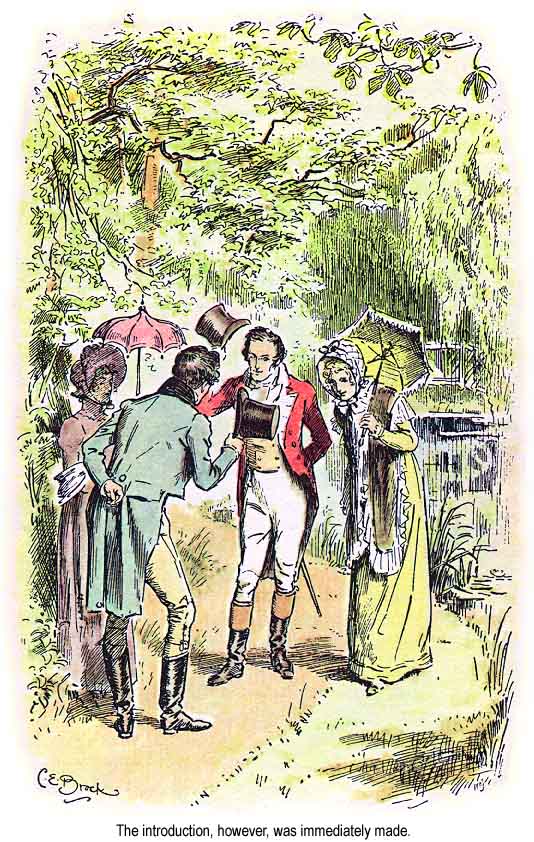
My other favorite example of ekphrasis is in Chapter 43 of Jane Austen's Pride and Prejudice. Darcy's miniature, his portrait, his gallery, his housekeeper and his sister, his home, his pond, his estate, indeed, the whole of Pemberley, show Darcy's excellent character. Entirely in his absence, his handsome, moderate, reasonable self is revealed. In the negative, as it were.

But then, in a moment of stunning drama, and to Elizabeth's great confusion, he appears unexpectedly from the outer edge of the estate. And he turns out to be as charming as his world, Pemberley, has suggested.

Elizabeth's visit to Pemberley is a turning point in the story. Elizabeth thinks with longing, in support of the satirical theme of the novel to marry well, "And of this place . . . I might have been mistress!" Elizabeth's visit is also in support of the deeper theme, of finding balance in marriage and in life, which in this case will consist in finding an excellent husband for the heroine, who by now has become our Elizabeth, and an excellent wife for Darcy.

Friday, November 13, 2015

The Shield of Achilles

"Ekphrasis" is a literary description of a beautiful object or work of art. In the greatest epic poem of Western civilization, Homer's Iliad, the shield of Achilles is the most famous and best example of ekphrasis.

Achilles's circular bronze shield depicts the cosmos in miniature in bands from the center out (Book Eighteen, lines 478 to 608). We understand from Homer's description that Achilles longs for the restoration of peace and the sweetness of everyday life, even as he takes the battlefield to restore these things to his people. (Of course, I am simplifying like crazy, and, if you think classical scholars don't argue over every one of these points, I am sorry to say that you are mistaken.)

In Homer's Iliad, Book Sixteen, Achilles's best friend Patroclus requests permission to lead the Myrmidons into battle wearing Achilles's armor. By disguising himself as Achilles, Patroclus hopes to surprise the enemy into stopping the fight and giving his men a break. Achilles agrees to the plan even as he himself sets aside his anger with Menelaus and so will soon return to the fight himself.

Far from calling for a temporary truce, Hector kills Patroclus, gloats over the body, puts the armor on himself, and rallies his troops around Patroclus. The Greeks and Trojans fight over the corpse all day long. At last, the Greeks take Patroclus off the battlefield and Achilles and the others spend the night in deep morning back at camp.

Achilles's armor, which had belonged to his father, is now in the enemy's hands, and so Achilles needs new armor for the duel he must engage in with Hector. Achilles' mother Thetis asks the god Hephaestus to forge this new armor. Ironically, because we are supposed to be familiar with Achilles' one weakness, his Achilles' heel, we know that when he was a baby, Thetis held him by the heel when she dipped him into the River Styx to protect him, but the heel itself, her handhold, remained un-dipped.

Look at this genius plotting! Everything that happens in the story seems to come naturally from what has gone before, even to the point of Achilles being in some measure responsible for Patroclus's death, because Patroclus was disguised as Achilles when he was killed.

The god Hephaestus (the Roman Vulcan) makes Achilles his own armor. Preparing for battle, Achilles puts on his greaves and helmet and picks up the shield, and the shield is described in a remarkable simile, in which we are once again poignantly reminded of the loveliness of ordinary life:

"Like the glow of a blazing fire from a lonely upland farm seen by sailors whom a storm drives over the plentiful deep far from their friends, so from Achilles’ splendid richly-ornamented shield the sheen rose to heaven (Book XIX in the section comprised of lines 338 to 424)."

Predictably, I guess, I cannot say everything I want to say about the shield of Achilles in one post. Let this be the start of a small series of posts.

Taken from http://aclassicaday.blogspot.com.

Tuesday, October 27, 2015

The Keystone Arch

"The Romans were the first builders in Europe, perhaps the first in the world, fully to appreciate the advantages of the arch, the vault and the dome." This statement, attributed to D.S. Robertson, author of Greek and Roman Architecture, 2nd edn., Cambridge 1943, p.231, is cited in Wikipedia's entry entitled "Arch."

Note, in this quotation, the correct use of an un-split infinitive, "fully to appreciate." Colloquially we may say, "to fully appreciate," but, if we have old-school training ("never split an infinitive"), we remember, somewhere in the back of our mind, that this usage is often seen as incorrect.

So, moving on.

A post-and-beam span, that is, an opening framed by two posts with a beam across the top, supports itself by distributing the weight of gravity from the center of the beam to the two sides and down the posts.

The keystone arch cannot support itself until the keystone, the wedge-shaped puzzle piece at the apex, is put into place. The arch is first built on top of a framework, called a "centering." The centering is removed when the arch becomes a true compression form with the placement of the keystone.

The arch supports itself by distributing the weight of gravity from the wedge-shaped keystone to the next wedge-shaped voussoir and the next, on down to the springers at the spring line. The spring line is defined by the two points at the base of the arch and the theoretical center point, "drawn" from the two lower points of the keystone and crossing at the spring line. The springers have trapezoidal tops and level bottoms to continue spreading the weight of gravity down the posts.

We have an example of an early keystone arch in the northern gate, one of seven, in the walls encircling Perugia, the capitol city of Umbria. The walls were built of limestone block between 600 and 300 BCE to protect the city from the enemy, Rome, about a hundred miles away.

The original settlers of Perugia, or in Latin, Perusia, were the Umbri, an ancient--and perhaps the most ancient--tribe in Italy.  They spoke Umbrian, an Italic language related to Latin and Oscan. But their neighbors in Etruria, the Etruscans, spoke an unrelated language, which some scholars now believe may be a Tyrsenian language like the Raetic language of the Alps and the Lemnian language of Lemnos.

By the time the Roman general Fabius Maximus Rullianus led a successful expedition against Perugia in 310 or 309 BCE, the Umbrians had intermingled with the Etruscans and Perugia counted itself as one of the twelve cities of the Etruscan League. According to Livy, our source in this matter, the Perugians lost the battle and were accorded a thirty-year truce with Rome.

In a rebellious move, Perugia took part in the Second Samnite War against Rome in 295 BCE and had to renegotiate the treaty. By 216 and 205 BCE, the city found it prudent to help Rome in the Second Punic War.

Then the city fell a third time, when Mark Antony's younger brother and supporter Lucius sought refuge there in 40 BCE. Octavian, the future emperor Augustus, besieged the city and Lucius was compelled to surrender. The city was burned to the ground, but, based on archaeological evidence, rebuilding began almost immediately.

Soon thereafter, as part of a public-works program, Octavian repaired the wall and the ancient northern gate of Perugia, whose Umbrian or Etruscan name, as far as I can tell, we do not know. He rebuilt the keystone arch that the Perugians had originally built and this gate soon became known as the Augustan Gate, Porta d'Augusta.

So, as they often did, the Romans adopted the keystone arch from the people they conquered and used it widely in bridges and aqueducts, triumphal arches and gates, vaults and domes.

Tuesday, October 13, 2015

Keystone Cops (or Kops)

The Keystone Cops starred in silent movies made by Canadian-born and American-based director and actor Mack Sennett (1880-1960) between 1912 and 1917. Sennett's company in 1912 was called Keystone Pictures Studio; hence, "Keystone Cops."

Slapstick--humor involving someone who, by his or her own clumsiness or ineptitude, becomes the butt of the joke--is as old as comedy. Someone on stage or film slips on a banana peel or takes a custard pie in the face or gets a whack on the rear end and we laugh uproariously. If we have gone out of our way to refine our sensibilities, we laugh uproariously, but still feel bad about making fun of our hapless victim.

The term "slapstick" comes from the battachio of Italian Commedia dell'Arte, a wooden prop of two slats held together at one end so that when one player smacks another player, the battachio makes a loud noise that sounds like it hurts, but does not.

To show slapstick in movies, Sennett used some special effects. He filmed at slow speed so that the action looked faster than it was, and he had every fourth frame of film edited out so that the action looked jerky. I ran into a YouTube clip of a remastered Sennett film, which remastering in part involved fixing filming speed. But if these editors took out Sennett's special effects, I'm thinking that Sennett would not have wanted fixes like that.

In the Keystone-Cop version of slapstick, uniformed policemen chase a bad guy, but instead of calm thinking, quick action, and speedy resolution, they run off in all directions in disarray. The Keystone Cops first appeared in a comedy short, Hoffmeyer's Legacy, 1912 and became popular after their appearance in another short, the Bangville Police, 1913. Starting 1914, they no longer played starring roles, but became a background troupe for Charlie Chaplin and other silent-film stars.We know the names of the actors who played the first Keystone Cops, but the cast changed from movie to movie.

Here is the logo for Sennett's company in 1912:


As for the significance of the keystone in the logo, I will take that up in a later post. For now, let me just remark that Sennett probably chose "keystone" because it is a weighty term from classical architecture. The keystone is the final piece that allows a keystone arch to stand alone, without the scaffolding needed to construct it.

Monday, October 5, 2015

OCD (Obsessive Compulsive Disorder)

First, a joke, told by my friend Beth:

"I have CDO."

"What's that?"

"OCD with the letters in the right order."

The other day I was working on creating a bad-guy character for the thriller I'm writing. The story is set in 1952. I decided to make Del read every piece of writing that came his way, which is something I find myself doing. As if he, and I, could put together the meaning of the universe by assembling a complete book of these scraps.

For example, here is Del before he assassinates one of our heroes:

In the bathroom, he filled the hotel glass with tap water and dropped in two Alka-Seltzer tablets. “Keep tightly closed in a cool, dry place,” admonished the label on the bottle. When the drink had almost stopped fizzing, he chugged it down. Maybe that would take the edge off this hangover. 

He shaved, showered, parted and combed his hair, and put on a suit and tie.

Some breakfast couldn’t hurt either, he thought.

He went downstairs to the hotel restaurant and sat in a red leatherette booth at the window looking onto the street.

His waitress, “Dodie,” according to her nameplate, came over with the menu and the coffee pot. He turned over his coffee cup so that she could fill it for him. On the bottom of the cup, it said, “Buffalo China.”

Dodie poured his coffee. “What can I get for you, sir?” she said.

He looked at the menu. “I’ll have two eggs over easy, two pieces of buttered white toast, hash browns, sausage links.” He kept the menu so that he could read the whole thing while he ate.

Dodie brought his breakfast, kept his coffee cup full, and without a word replaced the heavy white napkin—embroidered in blue with the words “Colonial Inn”—that he had dropped.

And, after the assassination:

Now it was time to call Chaz and let him know that General Brink was dead, the fixers could clean up his office, and the Pentagon press staff could release their version of the story.

He dialed nine to get outside the hotel switchboard and then zero to get a telephone operator.

“I want to place a long-distance call to Saigon, the U.S. Embassy. I’m calling for Chaz Darnell.”

“Yes, sir. I’ll put you through.”

He lit a Lucky Strike. He listened to a succession of clicking noises as operators connected him from Washington, D.C. to Los Angeles, Los Angeles to Honolulu, Honolulu to Saigon. He picked up the first cigarette from the ashtray and lit another one from the first.

He idly read the package. “Lucky Strike—It’s Toasted—Cigarettes.” He always bought himself a couple of packs of Lucky Strikes when he visited the states. These cigarettes were so much milder than the cigarettes he could get in Saigon.

“Chaz Darnell here.”

“It’s Del.”

“Hail the conquering hero!”

“It’s done.”

“I’ll take care of everything else, then.”

Maybe I've reached a sort of pact with my own quirks and oddities. My new motto: make my own idiosyncrasies work for me.


Saturday, September 12, 2015

Zero

Leonardo Bonacci (c. 1170 to c. 1250) also known as Fibonacci (or Filius--son of--Bonacci), was an Italian medieval mathematician. First, he introduced Arabic (originally Indian) numerals to the West. Second, he described the "Fibonacci number sequence," a beautiful and naturally-occurring spiral progression found in shells and flowers, even galaxies, and reproduced by artists from ancient Greek to post-modern as an ideal of proportion, the Golden Mean.

In 1202, Fibonacci published Liber Abaci (Book of Calculation), the first section of which introduces the Hindu–Arabic numeral system that he had encountered in the North African city, Bejaia. He tells us that the numerals 1, 2, 3, 4, 5, 6, 7, 8, and 9 come to us by way of India. The sign 0, he says, which "the Arabs call zephyr," صِفْر ‎(ṣifr, “nothing, cipher”), was originally śūnya in Sanskrit: शून्य.

Disclaimer: the first time I learned about the Fibonacci sequence was on February 25, 2005, when I watched the first season, sixth episode, "Sabotage" of a TV show called Numb3rs. Consider yourself  warned: I "understand" math, in a wordy sort of way, and I love the concepts, but I am not a mathematician. I hope you will check out this page about the Numb3rs episode, in which Charlie, the math-geek hero, explains more about the Fibonacci sequence.

If you had to learn to read and write Roman numerals, and, as a proponent of Western culture I really hope you did, you can imagine how difficult it would be to perform simple mathematical operations like addition and multiplication without the concept of zero or the idea of a numeral for a place-holder with no value of its own.

The first known English use of the word zero was in 1598, from French zéro, Italian zero (a contraction of zefiro), and Old Spanish cefr.

I promise nothing, but, in my research, I have run into a book by Charles Seife, Zero: The Biography of a Dangerous Idea (Viking, 2000) and a Scientific American article, "The Origin of Zero," by John Matson, August 21, 2009.

Friday, August 14, 2015

The Hanging Gardens of Babylon

The Greek historian Herodotus (484-425 BCE), the Alexandrian scholar Callimachus (ca. 305-240 BCE) and other classical writers list the Seven Wonders of the Ancient World, the great accomplishments and tourist attractions of known civilization at the time. All are within a 1000 x 1300 square-mile-area in the Eastern Mediterranean.
  • The Great Pyramid of Giza
  • The Hanging Gardens of Babylon
  • The Statue of Zeus at Olympia
  • The Temple of Artemis at Ephesus
  • The Mausoleum at Halicarnassus
  • The Colossus of Rhodes
  • The Lighthouse of Alexandria
Although the pyramid of Giza is the only wonder still in existence today, we know the locations of all the wonders except the hanging gardens of Babylon. (I discuss the pyramid of Giza in two posts from August 2014.)

Dr. Stephanie Dalley, Research Fellow (retired) in Assyriology at the Oriental Institute at Oxford University, published the Mystery of the Hanging Garden of Babylon (Oxford: Oxford University Press) in 2013 and wrote and hosted the TV show for the series, Secrets of the Dead, "The Lost Gardens of Babylon," in 2014. She has uncovered evidence that would place the hanging gardens not in Babylon, present-day Hillah in central Iraq, but a little over three hundred miles to the north in war-ravaged Mosul.

Ever one for the figurative properties of language, I learned that her deduction is based in part on the metaphorical use of a word in the Assyrian cuneiform writings of Sennacherib, king of Assyria (705-681 BCE). The word refers to the distinctive spiral markings of the date palm to describe Sennacherib's feat of engineering, the so-called Archimedean screw.

Along with a sophisticated system of canals and aqueducts, the screw, turned by men or animals, raised an estimated 300 tons of water a day from the Euphrates to the hanging gardens, which, like the city walls, were about forty feet above river level.

Until now, we had thought that Archimedes of Syracuse (ca. 287-212 BCE) discovered the screw, which makes it possible to lift water, grain, and the like mechanically and in quantity from lower to higher ground. Now, thanks to Dr. Dalley, we are thinking that a king from 400 years earlier dreamed up this machine by musing on the spiral pattern on the date trees growing in his garden.

Sunday, July 12, 2015

Tempest in a Teapot

In my post of April 18, 2015, I leveled a criticism at Helena Hamerow for a footnote in her book, Rural Settlements and Society in Anglo-Saxon England, and another at myself, for inexact wording that did not fully explain the uses of the moldboard plow in agriculture. If we are going to understand our history, we need to be specific and exact about the technological advances that shaped it.

Well, Hamerow returns to the moldboard plow later on in her book. (And serves me right for writing a post on a book I hadn't finished yet.) She says, "The greater frequency of certain arable weeds indicates . . . that heavier soils were increasingly being brought under cultivation in the Mid to Late Saxon period, something which could not have been readily achieved without the use of heavy ploughs pulled by teams of oxen . . . This implies the use of mouldboards and strip fields . . . At Drayton (Oxfordshire), 'broad, parallel stripes of clayey material'--dated archaeomagnetically to the Late Saxon period--were recognized as representing furrows created by a moldboard plough, producing 'a very distinctive sandwich of inverted alluvial clay, gravel and redeposited soil.'"

Too boring for you? Sorry, but I needed to exonerate Hamerow and set the record straight.

Tuesday, June 23, 2015

The Ice Palace

My new heroine, Rosalie, readily told me several things about herself, and I think she could do that because she is "born," so to say, to live out the story I am creating for her. (My old heroine, Mrs. Shepard, would not even tell me her first name.)

Rosalie was born in Michigan, moved to Washington, D.C., with her parents and sister, and graduated from a good women's college nearby. In 1950, she applied for a job in the diplomatic corps and ended up working for Edmond A Gullion, the U.S. Chargé d'affaires at the American embassy in Saigon.

Soon after she moves to Saigon and finds an apartment near her office in Cholon, Saigon's Chinatown, Rosalie's parents are killed by a drunk driver in a head-on car crash in Washington, D.C. Rosalie returns home for the funerals and takes her sister Penelope, known as Pen, back to Saigon with her. Pen is only 19, not independent enough to live by herself in the states.

Do you hate it when fiction writers start talking about their characters as real people? Me, too. But I'm pretty sure it's an authentic experience, and in this case I'm going to take it as a good sign. Rosalie is going to help me tell her story.

Rosalie spent her early years in Michigan, where it was snowy and icy in winter and hot and muggy in summer. Now she lives in Saigon, where the summer monsoon season takes the weather to a whole new, tropical, level of hot and muggy.

In one scene I am thinking about, she feels especially hot and sticky, so she imagines an ice palace like the people in her home town in Charlevoix used to build in the winter. She thinks about dressing for the cold, stomping on the floor to pack it down, and putting the ice blocks into place for the foundation. Later, in her mind, she walks around inside the ice palace until she becomes deliciously chilled.

I looked up Ice Palace in Wikipedia and came up with this wonderful old bit of Russian history. In 1739 to 1740, during a particularly cold winter in St. Petersburg, the Empress Anna Ivanova (1693-1740) was celebrating Russia's victory over the Ottoman Empire. She called for an ice palace to be built. She ordered a prince, now widowed, who had angered her by marrying a woman of a different faith, to become one of her court jesters and an ugly maidservant to become the other; the two were married.

On the wedding night, the empress sealed the newlyweds up in a bedchamber in the ice palace. The couple would have died overnight of the cold, except that the bride had managed to trade her pearl necklace for a guard's sheepskin coat.

According to the Wikipedia article, we know that the architect was Pyotr Yeropkin and the construction manager was Georg Kraft, and we still have Kraft's detailed description of the ice palace (only in Russian, as far as I can see).

Unfortunately, I probably won't be able to tell the story in the book I am writing about Rosalie. So I am regaling you with it here.

Sunday, June 21, 2015

Mansion

In the novel I've been working on, my heroine lives in 1940 London in a mansion block of flats. That is, if I can be said to be working on something involving ten years of research, many fits and starts, a partial outline, and one first chapter.

The word "mansion" has its root in the Latin word manere, to remain. In later Latin (my source is vague on the point of how much later, but I'm going to guess that the time is after 410 CE, when the Romans left England), mansio came to mean a place to stay during a journey.

Every twelve miles or so--the distance an ox-drawn cart can cover in a day--a large wayside inn or mansio provided food, lodging, and respite for the animals. Sometimes it also served as a government checkpoint, requiring travelers to show proper identification and pay road taxes. At least six sites have been identified as mansions in Great Britain; for one, the excavated mansion at Godmanchester on Ermine Street near Huntingdon, Cambridgeshire.

In Old French and late Middle English, mansion took on an additional meaning, a large, impressive house for an important person. The French word for house, maison, comes from mansion.

Lately, on a kind of journey of my own, if you will allow a lame play on words to help me tie this post together, I gave up on the novel I was working on and created a new heroine. I thought, what if I have somehow constrained myself with the old story and that is why I am having so much trouble moving forward? What if I set the work aside, or even pretend I've finished it and learned everything I can from it, and move on to something I can outline and write?

So I've started a story about a young woman, Rosalie, who, in 1952, works as a secretary in Saigon for the Military Assistance and Advisory Group, MAAG--I. This team of officers and enlisted men from Army, Navy, and Air Force, established in late 1950 under Brigadier General Francis G. Brink, supervises our handing over of World-War-Two-surplus weapons, trucks, and airplanes to the French Expeditionary Corps: the United States' first involvement in Viet Nam.

The French requested our aid in early 1950 and the MAAG--I is President Truman's response to that request. But, in fact, the French are working at cross-purposes with us. They do not want to build a nation resistant to Communism; they simply want to take Indochina back as a colonial power. Yes, this is the theme of Graham Greene's the Quiet American: the old theme of American innocence and naiveté up against European greed and corruption.

Except that, in my story (and in fact) the corruption has now spread to the Americans as well. The CIA (Central Intelligence Agency) helps the French restore the opium trade to finance covert ops. On a visit to the United States to attend a conference on Southeast Asian affairs, General Brink tells a friend at a party that he is worried about his own safety: he knows too much about what is going on in Saigon. On June 24, 1952, while sitting at his desk in the Pentagon, he shoots himself three times in the chest with a revolver. The coroner rules his death a suicide brought on by depression.

My story begins here, as Rosalie and the Army Chief Warrant Officer Tom try to figure out why General Brink was murdered and what to do about it.


Saturday, May 2, 2015

"Serves You Right"

A favorite saying in my family: "Well, it serves you right!" I should never have posted a criticism on a book I hadn't finished. (See my post from April 18, 2015, "The Moldboard Plow," which referred  back to another post from August 3, 2013, "Monticello Soup.")

On page 127 of Rural Settlements and Society in Anglo-Saxon England (Oxford University Press: Oxford, 2012), Hamerow clarifies the uses of the moldboard plow: "[H]eavier soils were increasingly being brought under cultivation in the Mid to Late Saxon period . . . . This implies the use of moldboards and strip fields, direct evidence for which is slowly but surely increasing. At Drayton (Oxfordshire), 'broad, parallel stripes of clayey material'--dated archaeomagnetically to the Late Saxon period--were recognized as representing furrows created by a moldboard plough, producing in section 'a very distinctive sandwich of inverted alluvial clay, gravel and redeposited soil.'

She cites another archaeologist, Booth, but I will spare you the details, just as I spared you the [sic]s that should have accompanied the English words, "moldboard plough."

Don't care about moldboard plows or agricultural technology? Or me annotating myself? Fine. Blame it all on Thomas Jefferson.